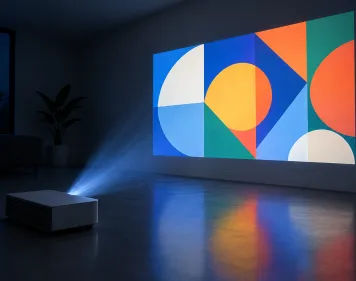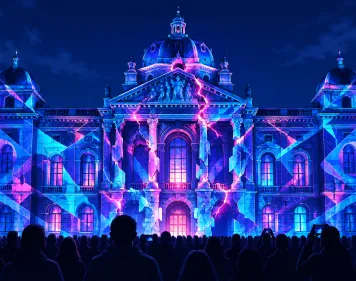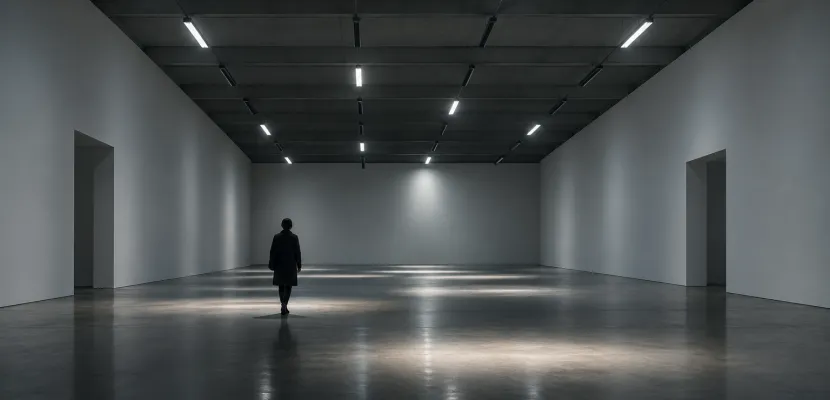
In 2001, Martin Creed won the Turner Prize for an empty gallery whose lights switched on and off every five seconds. An art installation is a work made from a whole space and everything in it. You usually walk into it and experience it over time, so you are inside the work instead of standing in front of it. The same two words also name a practical service, hanging art on walls, and this guide covers both meanings, with dated examples up to Tate Modern’s 2026 Turbine Hall commission.
Sketch notes
- Installation art treats the room, the light, the sound and the visitor as one artwork.
- “Art installation” can also mean hanging art, which Thumbtack prices at $55 to $165 per piece.
- The form runs from Schwitters’ Merzbau (1920–1936) to Tarek Atoui’s Hold at Tate Modern (until April 11, 2027).
- In the US, Dia’s Earth Room, the Brooklyn Museum’s Dinner Party and Turrell’s Skyspaces are lasting places to see it.
- Artists pricing site-specific work should charge for design and credit that fee if the client goes ahead.
Fact-checked
We checked these key facts against the sources named, on November 27, 2026:
- Salcedo’s Shibboleth was a crack running 548 feet (167 m) along the Turbine Hall floor (source: en.wikipedia.org)
- Ever Is Over All, Pipilotti Rist, 1997, first shown at the Venice Biennale, now in MoMA’s collection (source: moma.org)
- Thumbtack puts the cost of hiring someone to hang framed art in the US at about $55 to $165 per piece (source: thumbtack.com)
- Museums still commission the most ambitious work, and Tate’s partnership with Hyundai Motor now runs through 2036 (source: hyundaimotorgroup.com)
- Dia Art Foundation, founded in New York in 1974, became the key US patron of works that needed a permanent room of their own (source: en.wikipedia.org)
What is an art installation?
An art installation is an artwork that uses a whole space as its material. Objects, light, sound, video and architecture are arranged so that you experience them together, usually by walking into them. Tate describes installation art as large-scale, mixed-media constructions, often designed for a specific place or for a temporary period of time.
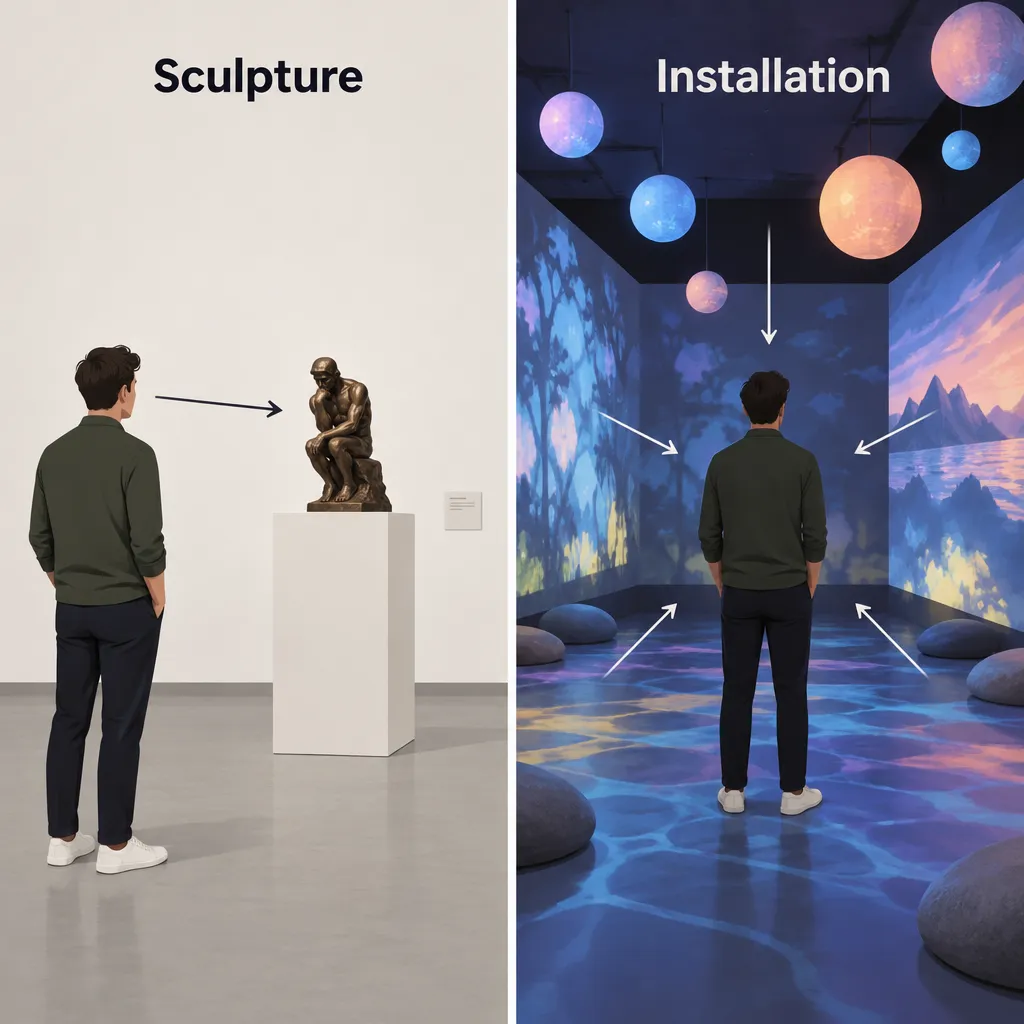
A simple way to hold the idea is space plus materials plus viewer equals the work. A painting still works if you move it to another wall. An installation often doesn’t, because the size of the room, the way light falls and the route you take through it are part of the artwork itself.
Installation is also not a movement or a style. The Irish Museum of Modern Art (IMMA) frames it as a mode of production and display. It is a way of making and showing art that painters, sculptors, video artists and coders all use. That is why a minimalist like Walter De Maria and a feminist artist like Judy Chicago can both count as installation artists while having almost nothing else in common.
Installation art vs. art installation: same words, two jobs
“Installation art” is the name of the artform. “An art installation” usually means one example of that artform, such as Olafur Eliasson’s The Weather Project. In trade and home-decor use, “art installation” also means the service of hanging framed work, mirrors and sculpture safely. Art handlers and installers do that work, and it is not an artwork.
When people search “how much does an art installer cost?”, they almost always mean the hanging service. When they ask what an artist should charge, they mean the artform. Both are answered separately below.
Other names for it: environment, total installation, immersive work, site-specific work
In the late 1950s Allan Kaprow called his room-filling works “environments”. Ilya Kabakov used “total installation” for rooms that surround you completely. “Site-specific” means a work made for one place that loses its meaning if moved. “Immersive” is the current marketing word, used by venues like teamLab and Meow Wolf. All four overlap, and none is wrong.
Installation art vs. sculpture vs. immersive attraction
The difference lies in how you relate to the work. A sculpture is an object you look at from outside. An installation is a setting where the space and your experience over time count as part of the work. An immersive attraction uses the same methods but is built mainly as ticketed entertainment, and critics still argue over where art ends and attraction begins.
The “unified experience” test
Three questions settle most cases:
- Does it surround you, or does it treat the room as its frame? Most installations put you inside the work, but this is typical, not required. Tate points out that some installations are designed simply to be walked around and contemplated, and some are so fragile they can only be viewed from a doorway or one end of a room. De Maria’s Earth Room is the classic case: you look at it from the threshold and never step in.
- Is the space part of the work? If the room’s walls, light or acoustics were designed or chosen as material, the piece is an installation.
- Does time matter? Installations often unfold as you move, or change while you stand there, as in Creed’s lights or the live performances inside Atoui’s Hold.
Kabakov put the viewer at the center of the definition. Tate quotes him: “The main actor in the total installation, the main centre toward which everything is addressed, for which everything is intended, is the viewer.” According to Tate, Ilya and Emilia Kabakov made almost two hundred total installations over their career. One of them is The Man Who Flew into Space from His Apartment (1985), a cramped Soviet room with a hole blown through the ceiling.
When a sculpture becomes part of an installation
Sculptures often sit inside installations. Ai Weiwei’s Sunflower Seeds (2010) was made of more than a hundred million porcelain seeds, each a small sculpture. Spread across the Turbine Hall floor, they became a landscape. The test is whether the arrangement and the space carry the meaning. A single large bronze in a plaza is public sculpture. Add a designed soundscape, lighting and a path you have to follow, and the same bronze becomes part of an installation.
So is it still art if it’s “just a room with lights going on and off”? Creed’s Work No. 227: The lights going on and off (2000) is exactly that, and the Turner Prize jury rewarded it in 2001. The point of the work is that an ordinary gallery and the way you act inside it become the material. You don’t have to like it. It is clearly installation art, because the room, the timing and your awareness of yourself are the whole piece.
Is a selfie museum installation art?
Some of it is, and much of it isn’t. In her 2005 Tate Etc. essay “But is it installation art?”, and in her book Installation Art: A Critical History (Tate, 2005), the art historian Claire Bishop argued that the form matters because of what it asks of the viewer. It activates you and makes you aware of your own perception. A room built mostly as a photo backdrop, with no idea behind it beyond the photo, fails that test.
teamLab and Meow Wolf sit in between. teamLab is an art collective whose rooms respond to visitors, so they are interactive digital installations shown at theme-park scale. Meow Wolf began in 2008 as an artist collective in Santa Fe. Hundreds of artists build its venues, which include narrative installations, but the company runs them as entertainment businesses. The fair position is that the methods are installation art and the business model is an attraction, so judge each room on its own merits.
A short history: from Merzbau to the Turbine Hall
Installation art grew from 1920s experiments with whole rooms. It got a name through the “environments” of the late 1950s and entered museums from the 1960s onward. It boomed again in the 1990s, when a crashed art market and new interest in conceptual art pushed artists from saleable objects toward experiences. The 2020s added immersive venues that draw millions of visitors a year.
| Year | Work or event | Artist | Venue | Why it matters |
|---|---|---|---|---|
| 1920–1936 | Merzbau | Kurt Schwitters | His house, Hanover | An environment spread through several rooms; destroyed by bombing in 1943 |
| 1957 onward | First “environments” | Allan Kaprow | New York | Gave the form a name and built in sound and participation |
| 1959 | 18 Happenings in 6 Parts | Allan Kaprow | Reuben Gallery, New York | Turned the audience into participants |
| 1965 | Infinity Mirror Room (Phalli’s Field) | Yayoi Kusama | Castellane Gallery, New York | Mirrors make a small room feel endless |
| 1970 | Green Light Corridor | Bruce Nauman | Now Guggenheim collection | Architecture as a physical, uncomfortable experience |
| 1977 | The New York Earth Room | Walter De Maria | Dia, 141 Wooster St, SoHo | A permanent indoor earthwork, on view since 1980 |
| 1985 | The Man Who Flew into Space from His Apartment | Ilya Kabakov | Centre Pompidou collection | The model of the “total installation” |
| 2000 | Unilever Series begins | Louise Bourgeois first | Tate Modern Turbine Hall | Commissions made for the world’s most visible installation space |
| 2003 | The Weather Project | Olafur Eliasson | Tate Modern | Over two million visitors |
| 2015 | Hyundai Commission begins | Abraham Cruzvillegas first | Tate Modern | Replaced the Unilever Series (2000–2014) |
| 2026 | Hold | Tarek Atoui | Tate Modern | Eleventh Hyundai Commission, a sound installation |
Precursors (1920s–1950s)
Schwitters filled rooms of his Hanover home with grotto-like constructions and found materials. Marcel Duchamp’s exhibition designs of the 1930s and 1940s also treated the gallery as a medium, most famously the web of string at the 1942 First Papers of Surrealism show in New York. Nobody called these works installations at the time.
Did you know?
According to Tate, Kurt Schwitters’ Merzbau spread across several rooms of his own house in Hanover. Tate also notes that Kaprow’s first environment included five tape machines playing electronic sounds he composed, so sound was part of the form from the start.
Environments and happenings (1957–1970s)
Kaprow’s environments and happenings broke the line between art and audience. Through the 1960s and 1970s, other artists pushed the idea in different directions: Kusama, Nauman, the Light and Space artists in California (James Turrell, Robert Irwin) and the land artists. Some worked with perception, some with the body and some with landscape. Dia Art Foundation, founded in New York in 1974, became the key US patron of works that needed a permanent room of their own. Judy Chicago’s The Dinner Party (1974–79) showed that the form could carry a political history as well as a perceptual one.
The 1990s boom
Tate ties the boom directly to the art market: after the crash of the late 1980s, interest in conceptual art (art about ideas rather than objects) came back in the early 1990s, and installation was the natural format for it. Biennials multiplied, and Pipilotti Rist, Kabakov, Doris Salcedo and Janet Cardiff came to prominence. Claire Bishop’s Tate Etc. essay describes installation in this decade as the institutionally approved artform of choice. Even so, Tate’s essay on the term notes that only a tiny fraction of installation art ever enters its Collection, which shows how hard the form is to own.
The 2020s: immersive venues at scale
Today the biggest installation audiences are often outside museums. teamLab’s two Tokyo museums, Planets and Borderless, together recorded more than 4.2 million visitors in calendar year 2025, according to figures teamLab released in early 2026. Planets alone accounted for 2.51 million of those. Borderless reports a separate cumulative figure: over 4 million visitors from more than 185 countries since it reopened at Azabudai Hills in 2024, as of mid-2026. Meow Wolf says its venues have hosted almost 10 million guests in total. Museums still commission the most ambitious work, and Tate’s partnership with Hyundai Motor now runs through 2036.
Types of installation art
Most installations belong to one or more of eight types, sorted by what the work is made of and how you meet it. Many works combine several. Hold, for example, is site-specific, sound-based and temporary all at once.
| Type | Defining trait | Classic example (artist, year) | Typical materials and tech |
|---|---|---|---|
| Site-specific | Made for one place, meaning tied to it | Shibboleth, Doris Salcedo, 2007 | Building fabric, local materials |
| Immersive / environmental | Surrounds you completely | The Weather Project, Olafur Eliasson, 2003 | Mono-frequency lamps, mist, mirrors |
| Interactive / participatory | Changes in response to visitors | 18 Happenings in 6 Parts, Allan Kaprow, 1959 | Today: sensors, cameras, code |
| Light and space | Light and perception as the medium | Meeting, James Turrell, 1986 | Apertures, LEDs, controlled daylight |
| Sound | Space shaped by listening | The Paradise Institute, Cardiff & Miller, 2001 | Binaural audio, speakers, instruments |
| Video and new media | Moving image across rooms and surfaces | Ever Is Over All, Pipilotti Rist, 1997 | Projectors, screens, media servers |
| Public and outdoor | Outside the gallery, often permanent | Twilight Epiphany, James Turrell, 2012 | Earthworks, steel, programmed LED light |
| Ephemeral / temporary | Designed to end, decay or be used up | Sunflower Seeds, Ai Weiwei, 2010 | Perishable or consumable matter |
Site-specific
Site-specific work only fully makes sense where it was made. Salcedo’s Shibboleth was a crack running 548 feet (167 m) along the Turbine Hall floor. When it closed, the crack was filled, but the scar is still visible. De Maria’s New York Earth Room is site-specific in a quieter way: the soil only makes sense inside that SoHo loft.
Immersive and environmental
These works fill your senses. Eliasson’s Weather Project used a semicircle of mono-frequency lamps, a mirrored ceiling and fine mist to make an indoor sun. Visitors famously lay on the floor to find their reflections.
Interactive and participatory
The work needs you to act. Kaprow did this with instructions and performers. Today artists usually do it with cameras, depth sensors and code, which is why teamLab’s rooms bloom where you stand. The short build overview later on this page explains the basic model.
Light and space
Turrell’s Skyspaces frame the sky through an opening in the ceiling until it looks like a flat painted surface. Meeting (1986) at MoMA PS1 in Queens is the New York example, and Twilight Epiphany (2012) at Rice University in Houston adds a programmed LED sequence at sunrise and sunset. Light is both the subject and the material.
Sound
Sound installations shape how you move through space by what you hear. Cardiff and Miller use binaural recordings that feel physically present. Atoui’s Hold turns the Turbine Hall into an orchestra.
Video and new media
Rist’s projections wrap whole rooms in saturated color. Large video works, projection mapping and generative pieces running live code all fall here. The site’s guide to new media art surveys the landmark works in more depth.
Public and outdoor
Public installations live in streets, parks, campuses and landscapes, and are often commissioned through percent-for-art schemes. Many are permanent. Others, such as festival light works, last a few nights.
Ephemeral and temporary
Some works are designed to disappear. Ephemeral pieces raise the hardest questions for collectors and conservators, which the conservation section below covers.
Famous installation art examples, and why each matters
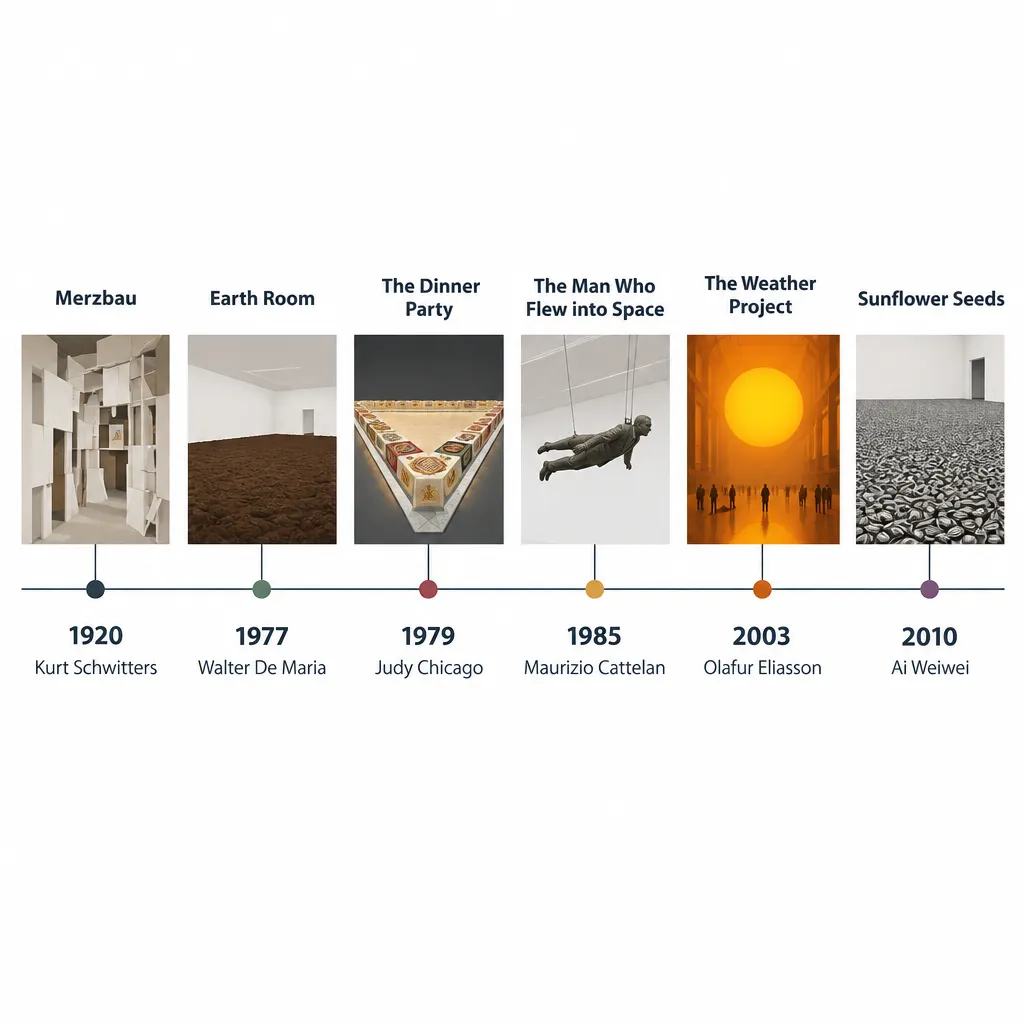
The 20 works below were chosen for their influence on the medium, the critical attention they received and the range of types they cover. US-sited works are weighted more heavily so that many of them can be seen in person. Each entry gives artist, year and venue or collection, so you can look up images and documentation.
Before 2000
- Merzbau, Kurt Schwitters, Hanover, 1920–1936. A home turned into an evolving environment, the model for later room-scale work.
- 18 Happenings in 6 Parts, Allan Kaprow, 1959, Reuben Gallery, New York. Audiences moved between rooms on instruction and became part of the event.
- Infinity Mirror Room (Phalli’s Field), Yayoi Kusama, 1965, Castellane Gallery, New York. Mirrors and stuffed fabric forms made infinity something you can stand inside.
- Green Light Corridor, Bruce Nauman, 1970, Guggenheim collection. A narrow, green-lit passage you feel in your body more than you see.
- The Dinner Party, Judy Chicago, 1974–79, Brooklyn Museum. A triangular banquet table with 39 place settings honoring women from history, permanently installed in the museum’s Elizabeth A. Sackler Center for Feminist Art.
- The New York Earth Room, Walter De Maria, 1977, Dia, 141 Wooster Street, SoHo. According to Dia, 250 cubic yards (197 m³) of earth cover 3,600 square feet (335 m²) of floor to a depth of 22 inches (56 cm), weighing 280,000 pounds. It has been on view since 1980, and you see it from the doorway.
- The Man Who Flew into Space from His Apartment, Ilya Kabakov, 1985, Centre Pompidou. The defining “total installation”, where one room tells a whole story.
- Meeting, James Turrell, 1986, MoMA PS1, New York. A Skyspace that turns the sky into a perceptual event.
- Ever Is Over All, Pipilotti Rist, 1997, first shown at the Venice Biennale, now in MoMA’s collection. Two overlapping projections, one of a woman cheerfully smashing car windows with a flower.
- Museum of Contemporary African Art, Meschac Gaba, 1997–2002, Tate collection. A twelve-room “museum” that questions who gets to run museums.
2000–2019
- Work No. 227: The lights going on and off, Martin Creed, 2000. Turner Prize 2001, and still the go-to case when people ask whether minimal installations count.
- Cloaca, Wim Delvoye, 2000, first shown at MuHKA, Antwerp. A machine that digests food mechanically, a satire on art, science and markets.
- The Paradise Institute, Janet Cardiff and George Bures Miller, 2001, Canadian Pavilion, Venice Biennale. A miniature cinema where headphones blur the line between the film and the room.
- Fireflies on the Water, Yayoi Kusama, 2002, Whitney Museum of American Art. A dark mirrored room with a pool at its center and about 150 small hanging lights, made to be seen alone. During its 2012 Whitney showing, visitors entered one at a time for one minute.
- The Weather Project, Olafur Eliasson, 2003–04, Tate Modern. Drew over two million visitors and showed the Turbine Hall could be a public gathering space.
- Shibboleth, Doris Salcedo, 2007, Tate Modern. A crack in the floor about borders, exclusion and division.
- Infinity Mirrored Room: The Souls of Millions of Light Years Away, Yayoi Kusama, 2013, The Broad, Los Angeles. One of the most queued-for rooms in any US museum.
Did you know?
Wim Delvoye kept upgrading his digestion machine. A second version, Cloaca – New and Improved, debuted at Zürich’s Migros Museum in 2001 and then ran at New York’s New Museum from January 25 to April 28, 2002, according to the New Museum’s exhibition archive.
2020s
- Timelapse, Sarah Sze, March 31 to September 10, 2023, Solomon R. Guggenheim Museum, New York. Site-specific works ran from the building’s exterior to the sixth level of Frank Lloyd Wright’s rotunda and the Tower gallery, ending at Timekeeper (2016). The show used the museum’s architecture as material.
- Goavve-Geabbil (closed April 2026), Máret Ánne Sara, October 14, 2025 to April 6, 2026, Tate Modern. The tenth Hyundai Commission, by a Sámi artist whose earlier Pile o’ Sápmi (documenta 14, 2017) protested state-enforced reindeer culls.
- Hold, Tarek Atoui, October 13, 2026 to April 11, 2027, Tate Modern. A multisensory sound installation of custom wind instruments, percussion, electronics and sculptural objects, with live sessions throughout the run. The Art Newspaper notes that it is the most sound-focused Turbine Hall work since Bruce Nauman’s Raw Materials (2004).
Where to see installation art right now (2026–27)
The most important new installation on view this winter is Tarek Atoui’s Hold in Tate Modern’s Turbine Hall, which runs until April 11, 2027 and is free to enter. In the US, the most reliable places are the permanent ones: Dia’s sites in New York, Turrell’s public Skyspaces and Kusama’s room at The Broad. For immersive work at scale, teamLab’s Japanese museums and Meow Wolf’s five US venues draw the biggest crowds.
| Venue | City | Opened | Milestone or what to expect | Status 2026–27 |
|---|---|---|---|---|
| Turbine Hall: Hold (Hyundai Commission) | London | October 13, 2026 | Eleventh Hyundai Commission, free entry | On view to April 11, 2027 |
| teamLab Planets | Tokyo (Toyosu) | 2018 | 2.51 million visitors in calendar 2025 | Open |
| teamLab Borderless | Tokyo (Azabudai Hills) | Reopened 2024 | Over 4 million visitors from 185+ countries since reopening, as of mid-2026 | Open |
| teamLab Biovortex Kyoto | Kyoto | October 2025 | 1 million visitors by July 6, 2026, about 42% international | Open |
| In the US | ||||
| The New York Earth Room (Dia) | New York (SoHo) | On view since 1980 | 280,000 pounds of earth, viewed from the doorway | Seasonal hours; check Dia |
| Dia Beacon | Beacon, New York | 2003 | Room-scale works in a former Nabisco box factory | Open |
| The Broad: Kusama’s Infinity Mirrored Room | Los Angeles | 2015 | Short timed visits, high demand | Open |
| The Dinner Party, Brooklyn Museum | New York (Brooklyn) | Permanent since 2007 | 39 place settings in the Sackler Center | Open |
| Twilight Epiphany Skyspace, Rice University | Houston | 2012 | Free, sunrise and sunset light sequences | Reopened September 15, 2026 |
| Meeting, MoMA PS1 | New York (Queens) | 1986 | Turrell Skyspace inside a former school | Open with museum admission |
| Meow Wolf | ||||
| House of Eternal Return | Santa Fe | 2016 | The original Meow Wolf venue | Open |
| Omega Mart | Las Vegas (AREA15) | 2021 | Fake supermarket leading into artist-built rooms | Open |
| Convergence Station | Denver | 2021 | Multi-level narrative world | Open |
| The Real Unreal | Grapevine, Texas | 2023 | Story-driven house and portals | Open |
| Radio Tave | Houston | October 31, 2024 | Newest open Meow Wolf venue | Open |
| Meow Wolf Los Angeles | 6081 Center Dr, Howard Hughes LA | Planned | Former Cinemark theater | Late 2026 or early 2027 |
| Meow Wolf New York | New York City | Announced | Seventh permanent location | Future opening |
Kyoto’s growth curve stands out. Biovortex reached 500,000 visitors about five months after opening and doubled that roughly four months later, according to teamLab’s July 2026 announcement. Rice University reported that Twilight Epiphany reopened after a closure of more than two years. Admission is free, no reservation is needed, and the sunset sequence starts about ten minutes before sunset, so arrive 10 to 15 minutes early for a seat.
Plan around the light
Turrell Skyspaces are best at the programmed sunrise and sunset sequences, not at midday. Look up the local sunset time and arrive early, because seats fill first.
Art installation in Las Vegas
Most people who search for an art installation in Las Vegas mean Omega Mart. It is a Meow Wolf fake supermarket inside AREA15, where freezer doors and shelves open into a sprawling world of artist-built rooms. AREA15 itself is an entertainment district with other immersive attractions. You piece the story together by exploring, so allow at least two hours.
Finding installations near you
The Public Art Archive, run by the nonprofit WESTAF, maps thousands of public artworks across the US and lets you filter by place. City arts commissions publish their percent-for-art collections, and university galleries often show student installations for free. For museum shows, check the current exhibitions page of your nearest contemporary art museum, since installations are usually listed as dated displays.
How interactive installations work: the short version
Every interactive installation follows the same model: input, logic, output. A sensor notices the visitor, software decides what that means, and a projection, light, sound or motor responds. Start with the visitor’s action, prototype at desk scale with a webcam and test in the real room before you buy hardware.
Quick steps: your first interactive installation
- Write one sentence on what the visitor does.
- Prototype with a webcam or mouse.
- Choose software that fits your output.
- Add one output: projection, light or sound.
- Test in the real room, then add failsafes.
Start with a webcam and move to a depth camera, such as an Intel RealSense or Orbbec unit, only when darkness or crowds break the webcam. For software, p5.js, Processing and openFrameworks are free. TouchDesigner from Derivative is free for non-commercial use, but output resolution is capped at 1280×1280, and commercial work needs a paid license. Many artists sketch an idea in p5.js and rebuild the show version in TouchDesigner, which handles projection mapping and multiple outputs out of the box. The site’s full build guide to making an interactive art installation covers sensors, software, projectors and opening-night reliability step by step.
Studio tip
Prototype with a webcam or a phone sending OSC before you buy a depth camera. If the interaction isn’t fun with a mouse, a $400 sensor won’t save it.
Heads up
Projectors and PCs in sealed plinths overheat. Plan ventilation and check that each device has a suitable power circuit before opening.
How much does art installation cost?
That depends on which meaning you have in mind. Thumbtack puts the cost of hiring someone to hang framed art in the US at about $55 to $165 per piece. Commissioning an installation artwork is priced per project and has no standard range. The quote is built from design fees, materials, fabrication, technology, installation days and maintenance.
| Service | Who does it | Typical price basis | Reported range | Source and period |
|---|---|---|---|---|
| Hanging framed art, mirrors | Art installer, handyman | Per piece | $55–$165 per piece | Thumbtack cost guide, 2026 |
| Hanging art in a design project | Installer via interior designer | Per hour, about 3 pieces an hour | $150 per hour | Business of Home art budget guide |
| Site-specific consultation | Artist or studio | Flat fee, credited if commissioned | $150–$500 | MOMAA commission pricing calculator, 2026 |
| Commissioned installation artwork | Artist studio and fabricators | Base price × site multiplier + install | Quoted per project | MOMAA commission pricing calculator, 2026 |
Hiring an art installer to hang work
Per-piece pricing suits a few frames, and hourly pricing suits gallery walls and big jobs. Business of Home’s budget example of $150 per hour at three pieces an hour works out to about $50 per piece, just under the bottom of Thumbtack’s range. Heavy mirrors, plaster or brick walls, high ceilings and multi-piece grids push the cost up.
Before you book an installer
Ask whether they charge per piece or per hour, and whether wall anchors, patching and travel are included. Those three items cause most surprise invoices.
Commissioning an installation artwork
A commission usually moves through consultation, proposal and design, engineering sign-off, fabrication, installation and handover. Each stage carries cost. Expect separate lines for materials, fabrication labor, AV or lighting hardware, software, shipping, insurance and technician days on site.
What drives the price up
Scale, permanence and technology drive cost the most. Outdoor and permanent works need engineering, weatherproofing and public liability cover. Interactive works add hardware, software licenses and ongoing maintenance. Tight deadlines, night-only access to a venue and union crews in some cities also raise the budget.
How much to charge for an art installation (for artists)
Price a site-specific installation as a base fee times a multiplier, plus costs. Set your base artist fee from your usual rates. Then apply a site-specific multiplier for the extra design work and risk, which is the method MOMAA’s 2026 commission pricing calculator uses. Add every material, technical and installation cost as a separate line. Charge for the design stage, and credit that fee if the client commissions the work.
Proposals should not be free. MOMAA’s calculator cites a $150 to $500 consultation fee for site-specific work, credited toward the commission if accepted. Free proposals train clients to treat your design thinking as worth nothing.
A line-item budget template
- Artist fee (base price × site-specific multiplier)
- Concept and design development, including drawings and renders
- Engineering or structural sign-off
- Materials, priced with a 10 to 15 percent contingency
- Fabrication labor and subcontractors
- Technology: sensors, projectors, computers, cabling, software licenses
- Shipping, travel and accommodation
- Installation and de-installation technician days
- Insurance during fabrication, transit and display
- Maintenance plan and documentation
If material and tech prices keep changing, quote materials as an estimate valid for 30 days, and add a clause that lets you re-quote hardware if the client delays. Before you quote, ask the client about budget range, deadline, site access, who owns the work afterward, how long it must last and who maintains it.
Deposits and payment milestones
Split payments so you never fund the client’s project. A common structure is 30 percent on signing, 40 percent at design approval and 30 percent on installation. Put it in writing, together with the scope, the number of revision rounds, the ownership terms, how the work may be reproduced and what happens if the project is cancelled.
Pricing tech: hardware, software licenses, maintenance
Treat hardware as a pass-through cost with a handling margin, or have the client buy it in their own name. Commercial software licenses, such as a paid TouchDesigner tier, belong in the budget, not in your fee. For permanent interactive work, sell a yearly maintenance contract. Sensors drift, projector lamps and light engines age, and operating system updates break things.
Art installation jobs and careers
Most people who physically install art work as art handlers, preparators or museum technicians. Interactive work also employs creative technologists and fabricators. Bureau of Labor Statistics wage data published through O*NET puts the national median pay for museum technicians and conservators at $51,440 (May 2025). The 10th percentile is $33,780 and the 90th is $87,530.
| Role | What the job involves | How people get hired |
|---|---|---|
| Art handler | Packing, moving, hanging and condition-checking works | Fine-art shipping firms, galleries, on-call crews |
| Preparator | Building walls and plinths, lighting, installing exhibitions | Museum and university gallery posts |
| Museum technician | Collection care, installs, registrar support | Museum studies, art degrees, internships |
| Creative technologist | Sensors, code, AV systems for interactive work | Portfolio of working projects |
| Fabricator | Building artists’ designs in metal, wood, resin, electronics | Workshop skills, studio assistant work |
Most handlers start on freelance crews and move into staff posts. Carpentry, careful lifting and calm problem-solving matter more than degrees. The broader BLS group of archivists, curators and museum workers has a median of $60,330 (May 2025), but entry-level crew rates in expensive cities often sit nearer the 10th-percentile figure. Studios hiring creative technologists want evidence. A portfolio of two or three installations that ran reliably beats any certificate.
Keeping installations alive: conservation, documentation and ownership
Installations are hard to keep because their parts change. Projectors go obsolete, software stops running, organic materials decay, and many works are meant to be reinstalled differently each time. In Installation Art and the Museum (2013), the researcher Vivian van Saaze showed that museums keep these works alive through ongoing decisions by curators, conservators and artists, not by freezing objects. The Earth Room shows what that looks like in practice: Dia has maintained the same soil in the same loft for more than four decades, including closures for conservation work.
That is why buyers of installation art often acquire a set of instructions and rights as much as physical things. For your own work, keep a reinstallation pack:
- Floor plans with dimensions, sightlines and visitor routes
- A hardware list with model numbers and acceptable substitutes
- Source code under version control, with dependencies and versions noted
- Wiring diagrams and network settings
- Video documentation of the work running, and of a full install
- A statement of what can change (screen brand, room size) and what can’t (color, timing, sound level)
A work with a clear pack can be shown again in twenty years. One without a pack usually can’t.
FAQ
What does art installation mean?
It means an artwork built from a whole space, combining objects, light, sound or video into an environment you usually enter and experience. In everyday trade use, it can also mean the service of hanging art on walls.
What is the difference between installation art and sculpture?
A sculpture is an object you look at from outside. Installation art makes the space, its atmosphere and your movement through it part of the work. A sculpture can be one element inside an installation.
Do you always have to walk into an installation?
No. Most installations surround you, but Tate notes that some are made to be walked around, or are too fragile to enter and are seen only from a doorway. De Maria’s New York Earth Room is the best-known example.
Is it “art installation” or “installation art”?
Both are correct. “Installation art” names the artform. “An art installation” names one work of that kind, or the service of hanging art.
What do you call an art installation?
Common terms are installation, environment, total installation (Ilya Kabakov’s term), site-specific work and immersive work. Museums usually just say “installation”.
How much does an art installer cost?
Thumbtack reports $55 to $165 per piece in the US. Interior-design budgets also quote hourly rates around $150, at about three pieces an hour. Ask what anchors, patching and travel add.
How much should I charge for an art installation?
Set a base artist fee, apply a site-specific multiplier and add itemized costs for design, materials, fabrication, tech, install days, insurance and maintenance. Charge a $150 to $500 consultation fee that you credit if the client goes ahead, and take staged payments.
What are famous examples of installation art?
Key works include Judy Chicago’s The Dinner Party (1974–79), Walter De Maria’s The New York Earth Room (1977), Eliasson’s The Weather Project (2003), Kusama’s Infinity Mirror Rooms (from 1965) and Fireflies on the Water (2002), Creed’s Work No. 227 (2000), Delvoye’s Cloaca (2000), Salcedo’s Shibboleth (2007), Turrell’s Skyspaces and Rist’s Ever Is Over All (1997).
Where can I see installation art in the US?
Permanent options include Dia’s Earth Room in SoHo and Dia Beacon, The Dinner Party at the Brooklyn Museum, Turrell’s Meeting at MoMA PS1 and Twilight Epiphany at Rice University in Houston, and Kusama’s room at The Broad in Los Angeles. Meow Wolf runs five US venues.
Who invented installation art?
No single person did. Kurt Schwitters’ Merzbau is the usual precursor, and Allan Kaprow’s environments from about 1957 gave the practice its early form and vocabulary.
Is Meow Wolf or teamLab installation art?
Their rooms use installation art methods, and teamLab’s responsive digital rooms are interactive installations by any definition. Both run as ticketed attractions, so critics who follow Claire Bishop’s line judge each room by whether it does more than give you a backdrop for photos.
Try it live
This short sketch shows the input, logic and output model of an interactive installation at desk scale. Your mouse stands in for a tracked visitor. Particles drift on Perlin noise and swirl around you while you’re “present”. Keep still for three seconds and the sketch decides you’ve left, the same way a real sensor times out. When you build for real, swap the mouse for camera or sensor data and keep the logic.
// Desk-scale prototype of an interactive installation.
// INPUT: the mouse stands in for a tracked visitor.
// LOGIC: a smoothed "presence" value rises when someone is here.
// OUTPUT: particles swirl and brighten around the visitor.

let particles = [];
let presence = 0;          // 0 = empty room, 1 = visitor fully present
let lastMove = -10000;     // time of the last movement in milliseconds
const COUNT = 700;
const TIMEOUT = 3000;      // stillness (ms) before the visitor counts as gone
let showInfo = true;

function setup() {
  createCanvas(800, 600);
  colorMode(HSB, 360, 100, 100, 100);
  noStroke();
  for (let i = 0; i < COUNT; i++) {
    particles.push({
      x: random(width),
      y: random(height),
      vx: 0,
      vy: 0,
      hue: random(170, 260)
    });
  }
  background(230, 40, 8);
}

// Any movement counts as the sensor "seeing" someone
function mouseMoved() { lastMove = millis(); }
function mouseDragged() { lastMove = millis(); }
function touchMoved() { lastMove = millis(); return false; }

function draw() {
  // A translucent background leaves soft light trails
  background(230, 40, 8, 15);

  // 1. INPUT: is the visitor on the canvas and recently moving?
  const onCanvas = mouseX >= 0 && mouseX <= width && mouseY >= 0 && mouseY <= height;
  const visitorHere = onCanvas && millis() - lastMove < TIMEOUT;

  // 2. LOGIC: ease presence up or down so changes feel calm, not jumpy
  presence = lerp(presence, visitorHere ? 1 : 0, 0.02);
  const t = frameCount * 0.003;

  for (const p of particles) {
    // Drift along a slowly changing noise field
    const angle = noise(p.x * 0.004, p.y * 0.004, t) * TWO_PI * 2;
    p.vx += cos(angle) * 0.08;
    p.vy += sin(angle) * 0.08;

    // Swirl around the visitor, scaled by presence
    if (presence > 0.01) {
      const dx = mouseX - p.x;
      const dy = mouseY - p.y;
      const d = sqrt(dx * dx + dy * dy) + 1;
      const pullStrength = d < 50 ? -0.4 : 0.25; // keep a small halo around the body
      p.vx += (dx / d) * pullStrength * presence + (-dy / d) * 0.15 * presence;
      p.vy += (dy / d) * pullStrength * presence + (dx / d) * 0.15 * presence;
    }

    // Damping and a speed limit keep the motion smooth
    p.vx *= 0.95;
    p.vy *= 0.95;
    const speed = sqrt(p.vx * p.vx + p.vy * p.vy);
    if (speed > 4) {
      p.vx = (p.vx / speed) * 4;
      p.vy = (p.vy / speed) * 4;
    }
    p.x += p.vx;
    p.y += p.vy;

    // Wrap around the edges like an endless room
    if (p.x < 0) p.x += width;
    if (p.x > width) p.x -= width;
    if (p.y < 0) p.y += height;
    if (p.y > height) p.y -= height;

    // 3. OUTPUT: color warms and dots grow as presence rises
    const h = (p.hue + presence * 80) % 360;
    fill(h, 70, 60 + presence * 40, 80);
    circle(p.x, p.y, 2 + presence * 2.5);
  }

  // Debug overlay, the kind you hide before doors open
  if (showInfo) {
    fill(0, 0, 100, 85);
    textSize(13);
    const state = visitorHere ? 'visitor detected' : 'room empty';
    text('presence ' + nf(presence, 1, 2) + '   ' + state, 12, 22);
    text('Move to enter. Stay still for 3 s to leave. Press D to hide this text.', 12, height - 14);
  }
}

function keyPressed() {
  if (key === 'd' || key === 'D') showInfo = !showInfo;
}
The best next step is to see one of these works in person. A single visit to the Earth Room, a Skyspace at sunset or Hold in the Turbine Hall will show you how much the room itself carries, which photos can’t. Bring that sense of the space back to your own sketches.
On this article
- Facts were checked against the sources below before publication.
- Published
Sources (8)
- Installation art | Tate (tate.org.uk)
- Hyundai Commission: Tarek Atoui: Hold | Tate press release (tate.org.uk)
- Tarek Atoui turns Tate Modern's Turbine Hall into a giant experimental orchestra | designboom (designboom.com)
- Turbine Hall 'sound vessel': artist Tarek Atoui on his Tate Modern commission | The Art Newspaper (theartnewspaper.com)
- Hyundai Commission: Máret Ánne Sara: Goavve-Geabbil | Tate (tate.org.uk)
- Five things to know: Ilya and Emilia Kabakov | Tate (tate.org.uk)
- But is it installation art? | Tate Etc. (tate.org.uk)
- teamLab Biovortex Kyoto surpasses 1 million visitors | Business Wire (businesswire.com)