Skip to content
Demos Lab
  • p5.js
  • TouchDesigner
  • Generative Art
  • Installations
  • Physical Computing
  • Tools
  • Media Art
  • About

Generative Art and Shaders: Making Images With Code

This hub collects Demos Lab's guides to making art with code, from the algorithms and noise functions behind organic patterns to GLSL shaders that render in real time on the GPU. It is for creative coders, designers and artists who want to understand how generative systems work and then build their own.

What you'll find here

Algorithms and noise

These guides explain the building blocks of generative work, including Perlin and simplex noise, flow fields, recursion, L-systems and seeded randomness you can reproduce.

GLSL shader techniques

Fragment shader walkthroughs cover signed distance functions, raymarching, domain warping and the math that turns a pixel coordinate into a moving image.

Plotter and physical output

Practical advice covers turning code into pen plotter drawings, from exporting clean SVG paths and optimizing line order to choosing paper and pens that hold up.

Generative design and AI tools

These pieces look at how parametric systems and creative AI tools fit into an artist's workflow, with clear takes on where they help and where hand-written code still does the job better.

Home » Generative Art & Shaders
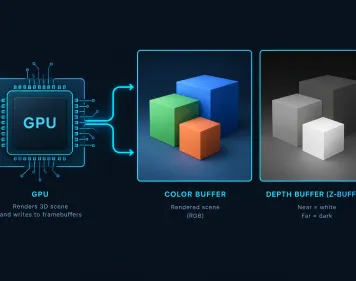
Depth Testing Hero
November 9, 2026 by Demos Lab Editorial Team
Generative Art & Shaders

Depth Testing in the Graphics Pipeline Explained

A fresh WebGL context draws in painter’s order: the last thing you draw lands on top, because depth testing stays off until you call…

Read article →
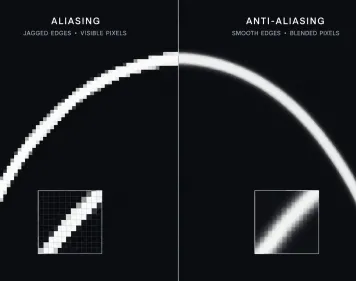
Anti-Aliasing Hero
October 25, 2026 by Demos Lab Editorial Team
Generative Art & Shaders

Antialiasing Techniques Explained for Real Time Graphics

Anti-aliasing smooths the jagged, stair-stepped edges and shimmering patterns that appear when smooth shapes are squeezed onto a grid of square pixels. Every method…

Read article →
Perlin Noise Hero
October 21, 2026 by Demos Lab Editorial Team
Generative Art & Shaders

Perlin noise explained for creative coders

Perlin noise is a way to make randomness that changes smoothly. Nearby inputs give nearby outputs, so you get rolling hills, drifting smoke and…

Read article →
Latest experiments

  • Depth Testing Hero
    Depth Testing in the Graphics Pipeline Explained
  • 3D Camera LookAt Hero
    Aiming a 3D Camera with lookAt and Understanding the View Frustum
  • TouchDesigner DAT Node Hero
    What a DAT Is in TouchDesigner and What DAT Stands For
  • Analog Joystick Hero
    Analog Joysticks Explained for Custom Controllers and Arduino
  • Multimedia Artwork Hero
    What Makes a Multimedia Artwork and How It Uses Each Element

Sections

  • Creative Coding Tools (2)
  • Generative Art & Shaders (3)
  • Installations & Projection (1)
  • New Media Art (2)
  • p5.js & Processing (2)
  • Physical Computing (2)
  • TouchDesigner (2)

Demos Lab

Creative coding and interactive media art

Sections

  • Creative Coding Tools
  • Generative Art & Shaders
  • Installations & Projection
  • New Media Art
  • p5.js & Processing
  • Physical Computing
  • TouchDesigner

Latest

  • Depth Testing in the Graphics Pipeline Explained
  • Aiming a 3D Camera with lookAt and Understanding the View Frustum
  • What a DAT Is in TouchDesigner and What DAT Stands For
  • Analog Joysticks Explained for Custom Controllers and Arduino
  • What Makes a Multimedia Artwork and How It Uses Each Element

© 2026 Demos Lab.
  • About
  • Code & Credits
  • Privacy Policy
  • Terms of Use
×