In 1882 a French physiologist built a camera shaped like a rifle so he could photograph a gull in flight 12 times in one second. Chronophotography is the 19th-century method of taking photographs at short, equal intervals to study movement. This guide covers how Étienne-Jules Marey and Eadweard Muybridge did it, how chronophotography led to cinema, and three ways you can make a chronophotograph today: with a camera, by stacking photos, or live in p5.js.
Key takeaways
- Chronophotography records one movement at equal time intervals, as separate frames or as several phases on one plate.
- Muybridge used a row of cameras with one image each. Marey used several chronophotographic methods, including one camera that put many exposures on one plate.
- In his 1882 method, Marey’s black suit with reflective white lines was photographed against a dark background, so the white lines exposed the plate.
- For stacked frames, a lightening blend reveals brighter pixels and a darkening blend reveals darker ones, so choose by image polarity: usually Lighten on a dark background and Darken on a light one. Never use Mean or Median.
- A webcam and about 100 lines of p5.js can reproduce all three looks live.
Fact-checked
We checked these key facts against the sources named, on November 13, 2026:
- Victorian-cinema.net dates Marey’s fixed-plate period to 1882-1888 (source: victorian-cinema.net)
- Muybridge’s 12-camera sequences of 1878 came first and are usually counted as chronophotography too (source: bafybeiaysi4s6lnjev27ln5icwm6tueaw2vdykrtjkwiphwekaywqhcjze.ipfs.ipfs.hypha.coop)
- His zoopraxiscope, conceived in 1879 and built by January 1880, projected images painted from his photographs on spinning glass discs (source: en.wikipedia.org)
- The Metropolitan Museum of Art: holds Marey and Fremont’s 1894 blacksmith (1987.1054), Marey’s 1886 [Bird in Flight] and Demenÿ’s [Fencer] (source: metmuseum.org)
- On the viewing side, Muybridge’s zoopraxiscope (1879-1880) and Anschütz’s Schnellseher (1886-1887) showed audiences sequential photographs as movement (source: en.wikipedia.org)
What is chronophotography?
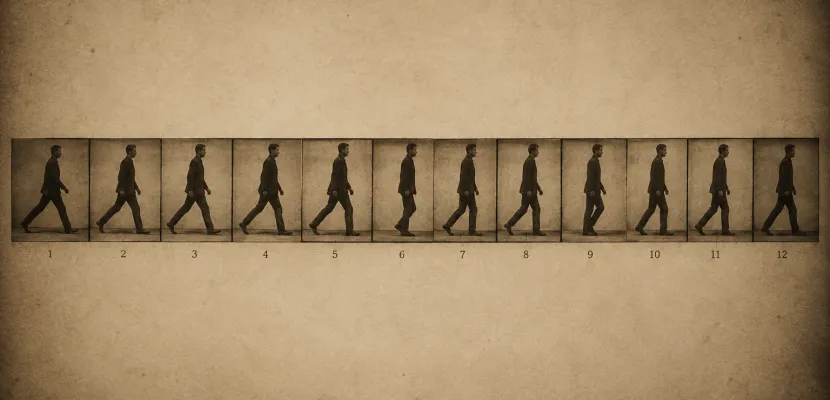
Chronophotography is a series of photographs taken at short, equal time intervals so you can study a movement that happens too fast for the eye. The phases appear either as separate frames side by side, as in Eadweard Muybridge’s galloping horse, or overlaid on a single plate, as in Étienne-Jules Marey’s walking figures and birds.
Each approach produces a different kind of picture. Muybridge’s sequences read like a comic strip: twelve small photographs, each frozen at one instant. Marey’s plates read like a diagram. One figure appears again and again across the frame, so you see the path of the movement in a single view.
Chronophotograph vs. chronophotography
A chronophotograph is a single image or set of images made this way. Chronophotography is the technique and the field. The adjective is chronophotographic, as in Marey’s “chronophotographic gun” or “the chronophotographic method”. You will also see the spellings “chrono photography” and “chrono-photo” in searches and old catalogues. They mean the same thing.
Where the word comes from
The word joins the Greek chronos (time) to photography, which literally means “drawing with light”. Marey used the French term chronophotographie in the 1880s. It stressed what made the method scientific: every image carried a known time stamp, so you could measure speed and acceleration from the gaps between phases.
How chronophotography works
Every chronophotograph depends on three things: a fixed point of view, exposures at equal intervals, and a way to stop the phases from blurring into each other. Muybridge solved the last problem with many cameras. Marey solved it with one camera and a very dark scene.
MAREY: one camera, one plate, many exposures
  shutter opens at t1, t2, t3, t4 ...
  [ plate ]  ->  figure  figure  figure  figure   (all on one image)

MUYBRIDGE: many cameras, one frame each
  [cam1] [cam2] [cam3] ... [cam12]   triggered one after another
     |      |      |          |
  frame1 frame2 frame3 ... frame12   (separate negatives, shown in a grid)
Single plate, many exposures (Marey)
Marey’s fixed-plate camera kept one glass plate in place while a rotating shutter opened it at regular intervals. Every opening added another exposure of the subject in a new position. Because the camera never moved, the background stayed in the same place and the figure stepped across it. That gave a single image you could measure with a ruler, which suited a physiologist who wanted numbers.
The catch is that a plate keeps adding light. Anything bright in the background gets exposed again with each opening and soon burns the whole plate to white.
Many cameras, one frame each (Muybridge)
Muybridge lined up separate cameras along a track and fired them one after another. Each camera made one sharp negative, so a busy background did no harm. The trade-off was the spacing. Equal time intervals depend on how the cameras were triggered, and a viewer has to compare separate frames instead of reading one path.
Why the black suit and white lines worked
Marey’s fix for the burning plate was to make almost everything black. The subject stood in front of a black backdrop, often described as black velvet, wore a black suit, and had bright lines or buttons fixed along the limbs and on the joints.
On a photographic plate, black means no light reached the emulsion. A black background and a black body add nothing, however many times the shutter opens. Only the white lines leave a mark, so each exposure records a clean stick figure. Stack fifteen of them and you get a readable diagram of the stride. You do not get a grey smear.
Did you know?
According to Université Paris Cité’s Marey digital library, in December 1882 Marey asked his assistant Georges Demenÿ to buy “two tight-fitting costumes similar to those clowns wear, one white, one black”. The black one, worn with bright lines on the limbs, produced Marey’s “skeletal trajectories”, an analogue ancestor of motion capture.
This logic matters for everything in the workshop below. The rule from 1882 still holds in Photoshop and in code: keep the background dark and the moving parts bright, then combine the frames so the brighter pixel wins.
Marey vs. Muybridge: the two methods compared
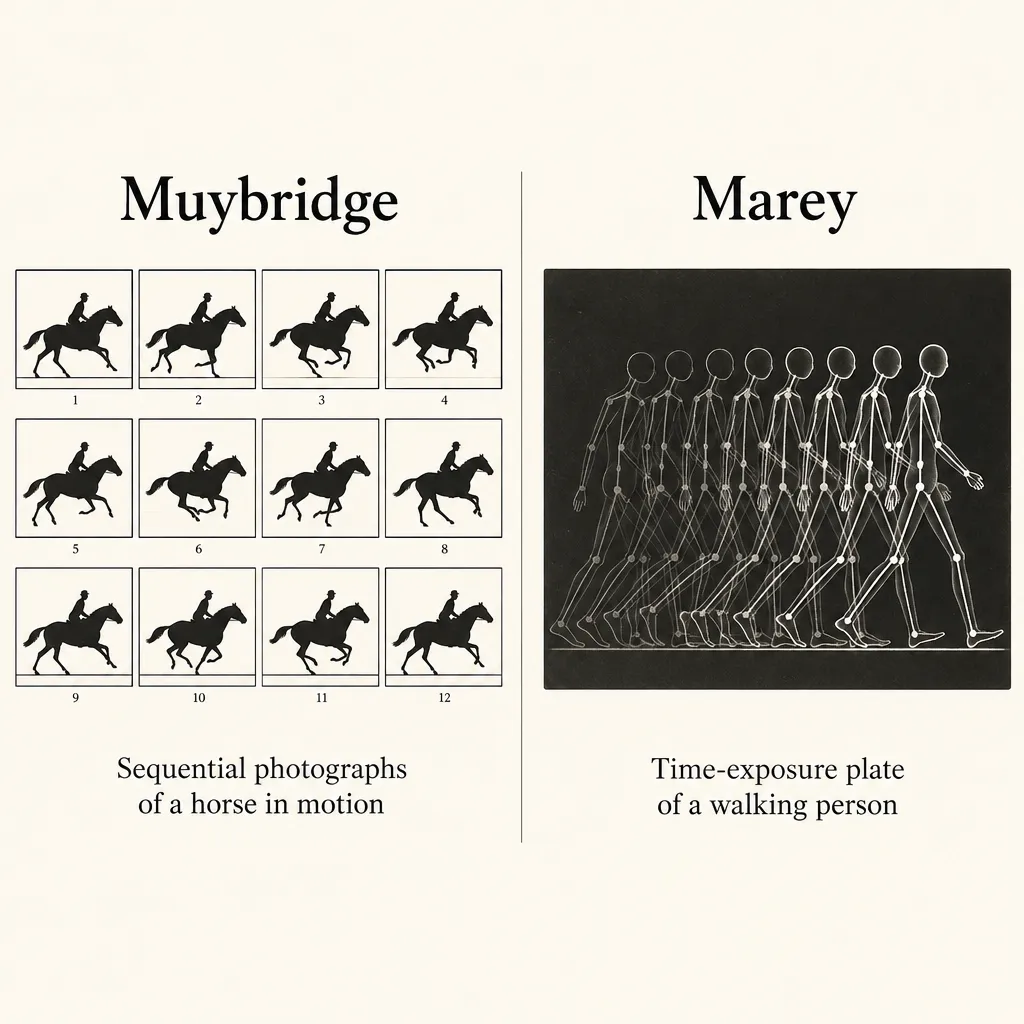
Muybridge, an English-born photographer working in California, wanted to show what a moving body looked like at each instant. Marey, a French physiologist at the Collège de France, wanted to measure motion as a continuous path. Their methods followed from those goals, and the German photographer Ottomar Anschütz added a third route aimed at showing movement to audiences.
| Pioneer | Key years | Method | Output | Goal | Key work |
|---|---|---|---|---|---|
| Eadweard Muybridge | 1878-1887 | Row of cameras fired in sequence | Separate negatives in grids | Show each instant of a movement | Animal Locomotion (1887) |
| Étienne-Jules Marey | 1882-1890s | Chronophotographic gun, then fixed-plate camera, then paper and film strips | Several phases on one plate, later strips | Measure movement as data | Le Vol des Oiseaux (1890) |
| Ottomar Anschütz | 1886-1887 | Sequential photos on glass plates viewed on a lit wheel | Moving image for audiences | Show motion as a spectacle | Schnellseher (Electrotachyscope) |
Muybridge’s galloping horse (1878)
In June 1878, at Leland Stanford’s Palo Alto farm, Muybridge photographed the mare Sallie Gardner with 12 cameras set along the track. The horse broke tripwires that fired the shutters one after another. The sequence showed that a galloping horse has all four hooves off the ground at one moment.
The detail that surprised people was when that happens. The hooves are not stretched out front and back like a rocking horse, which is how painters had shown the gallop for centuries. They are gathered under the body. Sources disagree on the exact day: the San Francisco Museum’s history page and others give 15 June 1878, while some accounts give 19 June. Both refer to the same session at Palo Alto.
Muybridge then turned his sequences back into motion. His zoopraxiscope, conceived in 1879 and built by January 1880, projected images painted from his photographs on spinning glass discs. He used it in public lectures from 1880 to 1895.
Marey’s chronophotographic gun (1882)
Marey’s first chronophotographic camera was a gun. According to Université Paris Cité’s Marey collection, he built the photographic gun in 1882. The astronomer Jules Janssen had developed his “photographic revolver” in 1874 to record the transit of Venus. Marey’s gun could take 12 exposures in one second, printed around the edge of a rotating plate.
He aimed it at gulls and other birds in flight. The pictures were small and the gun was hard to use, and Marey soon moved on. It remains the image most people connect with his name, partly because it looks so strange: a scientist “shooting” birds to study them, not to kill them.
The fixed-plate camera and the Station Physiologique
Later in 1882 Marey built a fixed-plate chronophotographic camera with a timed shutter that put several successive images of one movement on a single plate. The same year the Station Physiologique opened in Paris, funded by the City of Paris, with Georges Demenÿ as Marey’s assistant.
The station was an outdoor laboratory with a running track, a dark shed for the backdrop and a camera on rails. Sources place it either in the Bois de Boulogne or at the Parc des Princes. Both labels describe the same western edge of Paris, so the difference is one of naming, not a disagreement about where it stood. Victorian-cinema.net dates Marey’s fixed-plate period to 1882-1888. After that he replaced the plate with a paper ribbon coated in silver bromide emulsion, a step covered below.
Animal Locomotion: 781 plates (1887)
Muybridge’s largest project was shot in 1884-1885 at the University of Pennsylvania, which contributed $5,000. It was published in 1887 as Animal Locomotion: 781 collotype plates, drawn from 19,347 photographic images in 20 portfolios, showing people and animals in motion. Penn’s archives still hold the 1887 prospectus and catalogue, which describes the process, the equipment and the staff.
Animal Locomotion is Muybridge’s method at its fullest. Each plate is a grid of separate frames, often from several angles at once, against a background marked with a measuring grid. It reads as data, but as single frames, not Marey’s continuous trace.
Did you know?
According to a rare-book listing on the Antiquarian Booksellers’ Association of America site, a complete set of Animal Locomotion’s 781 plates cost $600 in 1887, and only 37 complete sets were sold. Most subscribers chose 100 plates for $100.
The forgotten pioneers: Demenÿ, Anschütz and Fremont
Histories of chronophotography usually stop at two names. At least three more people shaped it: Marey’s assistant Georges Demenÿ, the German photographer Ottomar Anschütz and the engineer Charles Fremont.
Georges Demenÿ
Demenÿ was more than a pair of hands. He ran the day-to-day work at the Station Physiologique from 1882, bought the famous black and white costumes, and often stood in front of the camera as the subject. His own interest was physical education. The Metropolitan Museum of Art holds his [Fencer] (1906), a chronophotograph the Met describes as part of his research on calisthenics. Demenÿ carried the method into sport and gymnastics after he and Marey went separate ways.
Ottomar Anschütz and the Schnellseher
Anschütz attacked the problem from the other side. He didn’t want to analyse movement. He wanted people to watch it. His Schnellseher of 1886, also called the Electrotachyscope, mounted 24 glass-plate photographs on a wheel about 1.5 metres across. A Geissler tube flashed in sync as each plate passed, and the wheel was cranked by hand to about 30 frames per second.
It was shown publicly in Berlin on 21-23 March 1887, and paying audiences watched it from June to September 1887. That is eight years before the Lumière brothers’ first paid screenings. Marey took it seriously enough to buy one of Anschütz’s Tachyscopes in March 1889.
Charles Fremont and the study of labour
Charles Fremont (1855-1930) used Marey’s method to study work. The Met holds a 1894 chronophotograph by Marey and Fremont (object 1987.1054), a gelatin silver print from a glass negative showing a blacksmith at the anvil. Fremont wanted to understand how efficiently a worker moved a hammer. This line of research leads to later time-and-motion studies and, much later, to ergonomics.
Birds, horses and humans: what chronophotography revealed
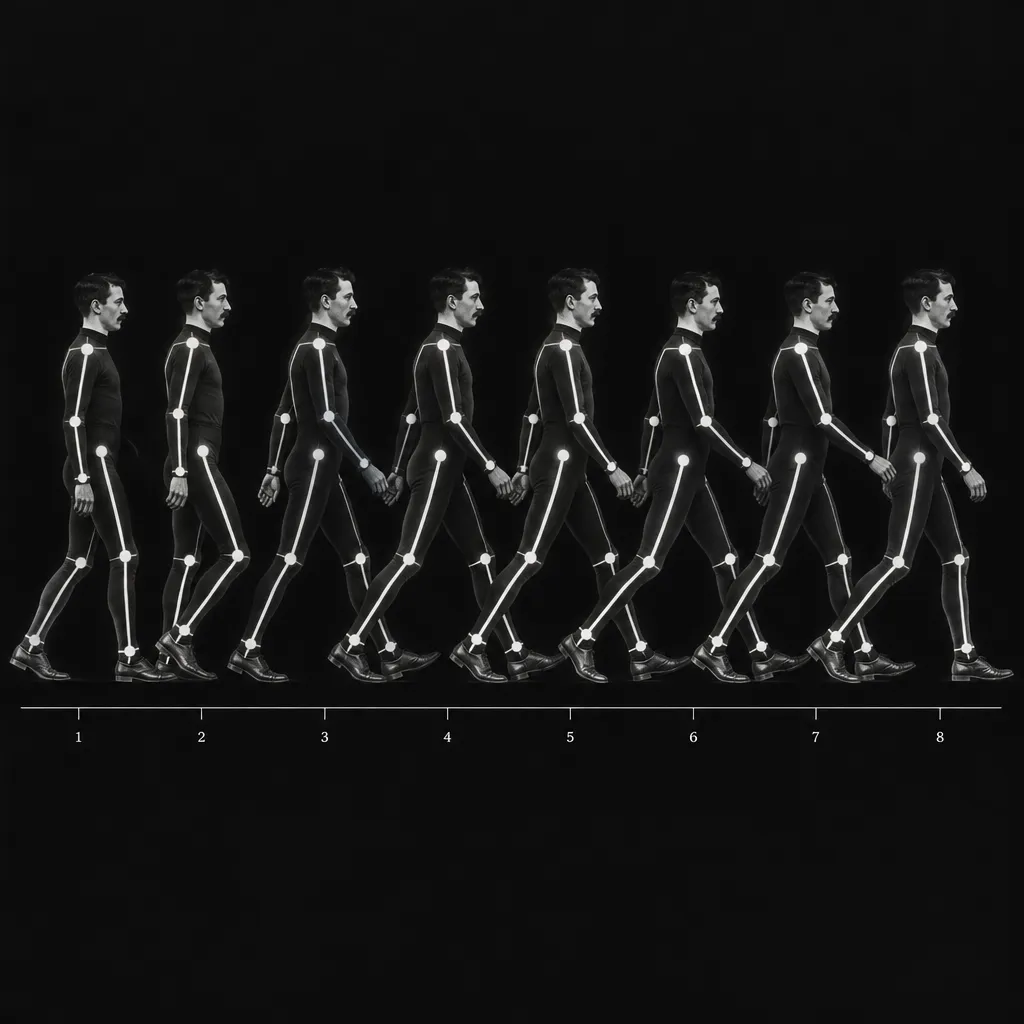
Chronophotography settled questions that the eye could not. Its three big subjects were birds in flight, the horse’s gait and human movement in sport and work.
Birds in flight
Marey’s study of flight ran from the gun pictures of 1882 to his 1890 book Le Vol des Oiseaux, published in Paris by G. Masson and illustrated with his chronophotographs, drawings and diagrams. For birds he chose overlapping phases on one image rather than separate frames, so you can read the full arc of the wing stroke.
He went further than photographs. Marey made sculptures of birds in flight, built from his sequences, so you could walk around a wingbeat frozen in three dimensions. The Science Museum Group holds a Chronophotograph of Pigeon in Flight, and the Met holds an 1886 [Bird in Flight] albumen print (object 2005.100.820).
The horse question
Did Muybridge prove that a galloping horse lifts all four hooves? Yes. The 1878 Sallie Gardner sequence shows a frame with every hoof off the ground. It also showed that this moment comes when the legs are folded under the belly, not stretched out. That overturned a convention painters had followed for centuries.
Human movement and sport
At the Station Physiologique, Marey and Demenÿ photographed soldiers, athletes, fencers and gymnasts walking, running and jumping. The black-suit “geometric” chronophotographs turned a runner into a set of lines whose angles you could measure frame by frame. Muybridge’s Animal Locomotion covered similar ground in separate frames. Together they gave physiologists, coaches and artists the first reliable picture of human gait.
From chronophotography to cinema
Chronophotography became cinema when the images moved from a single plate to a strip and from analysis to projection. Marey replaced his fixed plate with a paper ribbon coated in silver bromide emulsion, which Université Paris Cité’s collection calls a direct precursor of the cinematograph.
On the viewing side, Muybridge’s zoopraxiscope (1879-1880) and Anschütz’s Schnellseher (1886-1887) showed audiences sequential photographs as movement. Thomas Edison’s kinetoscope and the Lumière brothers’ cinématographe of 1895 combined both strands: a flexible strip of sequential frames, run fast enough to read as motion. Marey himself never cared much for cinema as entertainment. The tools he built for measuring motion were taken up by others to show it.
| Year | Event | Person | Source |
|---|---|---|---|
| 1874 | Photographic revolver records the transit of Venus | Jules Janssen | Université Paris Cité Marey collection |
| 1878 | 12-camera sequence of Sallie Gardner at Palo Alto | Eadweard Muybridge, Leland Stanford | San Francisco Museum |
| 1879-1880 | Zoopraxiscope conceived and built | Eadweard Muybridge | Kingston Museum, Google Arts & Culture |
| 1882 | Chronophotographic gun, about 12 exposures per second | Étienne-Jules Marey | Université Paris Cité |
| 1882 | Fixed-plate camera; Station Physiologique opens | Marey, Georges Demenÿ | Victorian-cinema.net |
| 1882 | Black costumes with white lines ordered | Marey, Demenÿ | Université Paris Cité |
| 1884-1885 | Animal Locomotion shot at Penn | Muybridge | University of Pennsylvania Archives |
| 1886 | Schnellseher built | Ottomar Anschütz | Electrotachyscope records |
| 1887 | Schnellseher shown in Berlin; Animal Locomotion published | Anschütz, Muybridge | Electrotachyscope records; Penn |
| 1889 | Marey buys a Tachyscope | Marey | Anschütz records |
| 1890 | Le Vol des Oiseaux published | Marey | Biodiversity Heritage Library |
| 1894 | Blacksmith chronophotograph | Charles Fremont, Marey | The Met, 1987.1054 |
| 1912 | Nude Descending a Staircase, No. 2; Dynamism of a Dog on a Leash | Marcel Duchamp, Giacomo Balla | Museum and critical records |
Chronophotography in art: Duchamp, Futurism and today
Chronophotography gave painters a new way to show time in a still image: repeat the figure and let the repetitions describe the motion. Within about 20 years of Marey’s plates it had reached the avant-garde, and it still shapes generative and interactive art.
Duchamp’s Nude Descending a Staircase, No. 2
Marcel Duchamp’s 1912 painting breaks a figure into overlapping angular planes walking down a stair. Duchamp acknowledged the influence of Marey’s chronophotography and of Muybridge’s Woman Walking Downstairs (1887) from Animal Locomotion. He denied any Futurist influence. The painting caused an uproar at the 1913 Armory Show in New York and now belongs to the Philadelphia Museum of Art.
Futurism: Balla
Giacomo Balla’s Dynamism of a Dog on a Leash (1912) brings Marey’s look into Futurist painting. The dog’s legs, the owner’s feet and the swinging leash repeat in blurred, fanned phases. The canvas is in the Buffalo AKG Art Museum. Where Duchamp turned the multiple exposure into Cubist geometry, Balla used it to show speed and energy, which was the Futurist creed.
Contemporary and digital chronophotography
The method is still alive in museums and in photography. The exhibition Étienne-Jules Marey: chronophotography, science and art ran at the Musée d’Histoire de la Médecine in Paris from 6 November 2025 to 18 February 2026, with loans from the Collège de France, as part of PhotoSaintGermain. It has now closed. In analogue photography, Photoweekend 2026 listed PIN-ANIMA, a series of multi-lens camera experiments inspired by Muybridge and Marey.
In creative coding, chronophotography lives on as frame buffers, motion trails and slit-scans. A 2010 Processing project featured on CreativeApplications.Net, Digital Chronophotography, blended webcam frames into one image. Today the same idea runs in the browser with p5.js, or as a Feedback TOP network in TouchDesigner. Projected live onto a wall or a dancer, it becomes a form of projection mapping. Combined with sound and sensors, it becomes the kind of piece people mean by multimedia artworks.
How to make a chronophotograph with a camera
To make a chronophotograph, lock the camera on a tripod, put a light subject against a dark background, and capture the movement at equal intervals. Then either combine the frames afterwards or let a stroboscopic flash record every phase on one exposure.
Quick steps: an in-camera chronophotograph
- Mount the camera on a tripod and frame the full path of the movement.
- Set manual focus, manual exposure and manual white balance.
- Use a dark background and dress the subject in light clothes or white tape on the joints.
- Pick burst, intervalometer or stroboscopic flash to match the speed of the movement.
- Shoot 6 to 12 evenly spaced phases with a remote release.
- Stack the frames with Lighten, or keep the single strobe exposure.
The methods below are ranked by how close the result comes to Marey’s single-plate look, how much gear they need and how forgiving they are for a first attempt. A method that needs only a phone ranks higher for beginners. Stroboscopic flash ranks highest for authenticity.
| Method | Gear | Frames per second / limit | Best for | Marey or Muybridge look |
|---|---|---|---|---|
| Burst mode + stacking | Camera or phone, tripod | Camera’s burst rate | Fast action: jumps, skateboarding | Either |
| Intervalometer + stacking | Camera with interval timer | One shot per set interval | Slow movement, dance, plants | Either |
| Stroboscopic flash | Speedlite with Multi or Repeating mode, dark room | Set in Hz; flash count capped by power level and heat | A true single-plate image | Marey |
| In-camera multiple exposure | Camera with multiple-exposure mode | A few exposures per frame | Simple overlays, no editing | Marey |
| p5.js webcam sketch | Laptop and webcam (free) | One phase every few frames | Live installations, teaching | Both, switchable |
Burst mode and intervalometer
Burst mode suits fast movements that last under a couple of seconds. Hold the shutter and the camera fires at its maximum rate. The intervals are steady as long as the buffer keeps up. An intervalometer fires one frame at a set interval, which suits slower movements such as a dancer’s turn.
Either way, use a shutter speed fast enough to freeze each phase. If each frame is blurred, the stack will be blurred too. Pick 6 to 12 frames from the burst, evenly spaced, before stacking.
Studio tip
Lock everything down: tripod, manual focus, manual exposure and manual white balance. If the camera changes exposure or colour between frames, the background shifts in the stack and every phase gets a visible seam.
Stroboscopic flash (the closest thing to Marey’s plate)
Stroboscopic flash makes a true single-plate chronophotograph: one long exposure in a dark room, with a flash firing several times while the shutter is open. Canon calls the mode Multi or stroboscopic flash, and Nikon calls it Repeating Flash. The number of phases is the flash frequency times the length of the exposure.
Worked example: set the flash to 10 Hz and 8 flashes, then use a 1-second exposure at a small aperture in a dark room. You get 8 phases of your subject, 0.1 seconds apart, on one frame. A black backdrop matters here exactly as it did for Marey. Ambient light will fill in a ghost of the whole movement, so turn it down.
Heads up
Stroboscopic flash heats the flash head. Canon’s 580EX II manual says to stop after 10 consecutive stroboscopic bursts and rest the flash for at least 15 minutes; Canon guides for other models cite about 30 firings and 10 minutes. Check your own manual.
Power is the other limit. On the 580EX II, full and half power are not available for stroboscopic flash. Lower output allows more flashes: 7 flashes at 1/4 power at 1 Hz, against 100 at 1/128. Canon also recommends a tripod, a remote release and an external power pack.
In-camera multiple exposure
Many mirrorless and DSLR bodies have a multiple-exposure mode that combines a few shots into one file. Some let you pick an overlay rule such as “bright” or “lighten”, which is the same rule as Marey’s dark plate. You get a finished image with no editing. The trade-off is that you cannot drop a bad phase later, and most cameras cap the number of exposures.
Phone apps and burst-to-composite
Is there a chronophotography app? Several phone apps offer “sequence” or “action shot” modes that combine a burst into one image. Check that the app lets you choose the number of frames. A simpler free route is to shoot a burst on your phone, export the frames and stack them as described below.
Be careful with the “Long Exposure” effect on iPhone Live Photos. It averages frames together, so a moving subject turns into a soft streak. That is the opposite of a chronophotograph.
Stacking frames in Photoshop (or free alternatives)
In Photoshop, choose File > Scripts > Load Files into Stack, select your frames, and tick the option to align them if the camera moved. Each frame becomes a layer. Select every layer above the bottom one and set the blend mode to Lighten if your background is dark, or Darken if it is light.
That answers the question many readers ask about combining around 16 frames into one image. Load all 16, set them to Lighten or Darken, then hide frames until 8 to 12 evenly spaced phases remain. Sixteen overlapping figures in a short space usually turn into mush.
Choosing the right blend mode
Photoshop also offers stack modes on a Smart Object (Layer > Smart Objects > Stack Mode). Maximum gives the same result as Lighten across layers, and Minimum matches Darken. Mean and Median are the trap. They exist to remove moving people from tourist shots, so they will erase your subject.
| Background | Blend mode | Result | When to use |
|---|---|---|---|
| Dark (black wall, night) | Lighten / Maximum | Every light phase stays crisp | Marey-style, white clothes or lit subject |
| Light (white wall, sky) | Darken / Minimum | Every dark phase stays crisp | Silhouettes, dark clothes on white |
| Mixed or busy | Manual layer masks | You choose what shows | Street scenes, sport on grass |
| Any | Mean or Median | Moving subject disappears | Never, for this look |
Free tools follow the same rules. GIMP’s layer modes are called Lighten only and Darken only, and Krita has Lighten and Darken. On the command line, ImageMagick does it in one line:
magick frame_*.jpg -evaluate-sequence max chrono.jpg magick frame_*.jpg -evaluate-sequence min chrono.jpg
Masking overlapping phases
If your background is neither dark nor light, use masks. Keep the first frame as a clean base, add a black mask to each layer above it, then paint white only over the subject in that frame. It takes longer, but it works on any background.
Why does a stacked image look like a blurry ghost instead of separate poses? Usually one of four reasons: you used Mean or Median, the background is brighter than the subject under Lighten, the shutter was too slow to freeze each frame, or the camera moved between shots.
Studio tip
Keep the number of phases low, roughly 6 to 12, and space them evenly. Too many overlapping exposures turn into mush, which is the problem Marey solved by blacking out the limbs and leaving only white lines.
Digital chronophotography with code
A webcam sketch can do live what Muybridge and Marey did with glass. In p5.js you keep a short history of frames, then either lay them out in a grid, blend them with LIGHTEST, or keep only the pixels that changed. If you are new to the library, p5.js is a free JavaScript library that runs in any browser. The full sketch is at the end of this article. The pieces below explain each mode.
All three modes read from a small 160 by 120 buffer called src, filled from the webcam. When no camera is available, the sketch draws a white stick figure walking on black: Marey’s black suit and white lines, rebuilt in code.
Mode 1: the Muybridge grid
Mode 1 grabs one frame every few draw calls, keeps the last 12 and lays them out as a contact sheet. Twelve is a nod to the 12 cameras at Palo Alto.
if (frameCount % EVERY === 0) {
  history.push(src.get());                  // copy the current frame
  if (history.length > PHASES) history.shift();
}
for (let i = 0; i < history.length; i++) {
  image(history[i], (i % 4) * 160, floor(i / 4) * 120, 160, 120);
}
At 60 frames per second, EVERY = 8 gives about 7.5 phases per second. Raise it for slow gestures and lower it for fast ones.
Mode 2: Marey’s single plate (lighten blend)
Mode 2 is a digital glass plate. It never clears unless you press C. Every few frames it draws the source onto the plate with blendMode(LIGHTEST), so each pixel keeps whichever value is brighter.
plate.blendMode(LIGHTEST);    // brighter pixel wins, like light on a plate
plate.image(src, 0, 0, 640, 480);
plate.blendMode(BLEND);
This is why lighting matters. In a bright room the plate fills up with white in seconds. Sit in front of a dark wall with a lamp from the side and wear something light, and you get Marey’s walking figures.
Mode 3: motion-only trails (frame differencing)
Mode 3 keeps only what moved. It compares each pixel with the previous frame. If the colour changed by more than a threshold, the pixel lights up. Otherwise its stored brightness fades a little each frame.
const d = abs(px[p] - prev[p]) + abs(px[p + 1] - prev[p + 1]) + abs(px[p + 2] - prev[p + 2]);
trail[i] = d > THRESH ? 255 : trail[i] * DECAY;
This is the closest thing to Marey’s skeletal trajectories. The still background disappears without any black velvet, and you see only the edges of the moving body, trailing off like a fading exposure. A DECAY of 0.93 keeps about a second of history. Try 0.98 for long, ghostly arcs.
Studio tip
Pixel loops get slow at full resolution. Do the maths on a 160 by 120 buffer and scale the result up with image(): that is 19,200 pixels per frame instead of 307,200 at 640 by 480.
Same idea in TouchDesigner
Yes, you can build the same motion-trail effect in TouchDesigner, which has a free Non-Commercial licence. Start with a Video Device In TOP. For a Muybridge grid, feed it into a Cache TOP and pull out evenly spaced frames with Cache Select TOPs, then lay them out.
For a Marey plate, build a Feedback TOP loop: combine the live frame with the feedback using a Composite TOP set to Maximum, and pass the feedback through a Level TOP with opacity just below 1 if you want it to fade. For frame differencing, compare the live frame with a one-frame-delayed copy using a Subtract or Difference composite, then accumulate the result through the same feedback loop. Derivative’s own Trails & Frame Delays tutorial argues that Cache TOP trails are crisper and easier to control than pure feedback.
The 2010 Processing approach still works too. Processing is free, and its blend() function with LIGHTEST maps one-to-one onto Mode 2.
Where to see and download original chronophotographs
High-resolution originals are spread across museums and libraries, and their rights differ. Check the licence on each object before you reuse an image.
- The Metropolitan Museum of Art: holds Marey and Fremont’s 1894 blacksmith (1987.1054), Marey’s 1886 [Bird in Flight] and Demenÿ’s [Fencer]. Images marked Open Access public domain are free for any use. Some records are restricted, so look for the public-domain label.
- National Gallery of Art, Washington: Marey’s Chronophotograph of a Man on a Bicycle, listed as free and in the public domain.
- University of Pennsylvania Archives: the 1887 Animal Locomotion prospectus and catalogue, a primary source on Muybridge’s equipment and staff.
- Université Paris Cité, Medica digital library (BIU Santé): digitised Marey books and an illustrated account of his methods, the source for the gun and costume details above.
- Science Museum Group: Chronophotograph of Pigeon in Flight. Collection images often carry a Creative Commons licence, so check the terms.
- Internet Archive (archive.org): scans of Muybridge’s plates and an animation item for the zoopraxiscope. Provenance varies, so cross-check against a museum record.
- MoMA: Marey’s Analysis of the Flight of a Pigeon by the Chronophotographic Method, useful for viewing but not for free reuse.
FAQ
How does chronophotography work?
A camera records one movement at short, equal intervals from a fixed viewpoint. Either a row of cameras makes one frame each (Muybridge), or one camera puts many exposures on a single plate (Marey). Marey kept the phases readable with a dark background and bright markers.
What is the difference between Marey and Muybridge?
Muybridge used many cameras and produced separate frames, usually shown as grids. Marey used one camera and overlaid several phases on one plate, showing the movement as a continuous path. Muybridge showed instants. Marey measured trajectories.
Who invented chronophotography?
Marey coined the term and developed the single-plate method from 1882. Muybridge’s 12-camera sequences of 1878 came first and are usually counted as chronophotography too. Jules Janssen’s 1874 photographic revolver was an important forerunner.
What is a chronophotographic gun?
It was Marey’s 1882 rifle-shaped camera. It took 12 exposures in one second on a rotating plate, and he used it mainly to photograph birds in flight.
Is chronophotography the same as stroboscopic or sequence photography?
They are close relatives. Stroboscopic photography is one way to make a chronophotograph: repeated flashes in one exposure. Sequence photography is the modern name for stacked burst shots. Chronophotography is the historical, scientific version of both.
How do I make a chronophotograph with my phone or camera?
Use a tripod, a dark background and a light subject. Shoot a burst, pick 6 to 12 evenly spaced frames, and stack them with Lighten (or Darken on a light background). With a camera and a speedlite, stroboscopic flash does it in one exposure.
Is burst mode or stroboscopic flash better for a sequence shot?
Burst mode is easier, works in daylight and lets you choose frames later. Stroboscopic flash gives a truer single-plate image with no editing, but it needs a dark room and is limited by flash heat. Start with burst and move to strobe for the Marey look.
How did chronophotography lead to cinema?
Marey moved from glass plates to sensitised paper strips, which pointed directly to film. Muybridge’s zoopraxiscope and Anschütz’s Schnellseher showed sequential photographs to audiences as motion. Cinema joined the strip and the projection.
Which artists were influenced by chronophotography?
Marcel Duchamp (Nude Descending a Staircase, No. 2, 1912) acknowledged Marey and Muybridge as influences. Giacomo Balla’s Dynamism of a Dog on a Leash (1912) carried the look into Futurism. Today creative coders build on it with motion trails and frame buffers.
Is there a chronophotography app?
Many phone apps and some camera bodies offer action-shot or multiple-exposure modes that do the stacking for you. The p5.js sketch below works as a free browser version with a webcam.
Did Muybridge prove a galloping horse lifts all four hooves?
Yes. His June 1878 sequence of Sallie Gardner at Palo Alto shows all four hooves off the ground at once, with the legs gathered under the body rather than stretched out.
Try it live
Run the sketch and press 1, 2 and 3 to switch between Muybridge’s grid, Marey’s plate and motion-only trails. Press C to clear and D to switch between your webcam and the built-in walker. Once it runs, try changing EVERY, PHASES and DECAY, or push the walker’s stride around with a little Perlin noise. Then point the webcam at a dark wall, put on a white shirt and walk past, the way Demenÿ did at the Station Physiologique.
// Digital chronophotography in three modes, after Muybridge and Marey.
// Keys: 1 = Muybridge grid, 2 = Marey single plate, 3 = motion trails,
// C = clear, D = switch between webcam and the built-in demo walker.
// No webcam (or permission denied)? The demo walker runs instead.

let cam, src, plate, outImg, prev, trail;
let history = [];
let mode = 1;
let useDemo = false;

const W = 160;      // small working size keeps the pixel loops fast
const H = 120;
const EVERY = 8;    // grab one phase every 8 frames (about 7.5 per second at 60 fps)
const PHASES = 12;  // Muybridge's 1878 horse used 12 cameras
const THRESH = 60;  // how much a pixel must change to count as motion
const DECAY = 0.93; // how slowly motion trails fade (closer to 1 = longer)

function setup() {
  createCanvas(640, 480);
  pixelDensity(1);
  cam = createCapture(VIDEO);
  cam.size(W, H);
  cam.hide();
  src = createGraphics(W, H);
  src.pixelDensity(1);
  plate = createGraphics(640, 480);
  plate.pixelDensity(1);
  plate.background(0);
  outImg = createImage(W, H);
  trail = new Float32Array(W * H);
  textSize(14);
}

function draw() {
  background(0);
  updateSource();
  if (mode === 1) drawGrid();
  if (mode === 2) drawPlate();
  if (mode === 3) drawTrails();
  noStroke();
  fill(255);
  text('1 grid   2 plate   3 trails   C clear   D webcam/demo', 10, height - 12);
}

// Fill the small source buffer from the webcam, or the demo walker if there is no camera
function updateSource() {
  const camReady = cam.elt && cam.elt.readyState >= 2;
  if (camReady && !useDemo) {
    src.image(cam, 0, 0, W, H);
  } else {
    drawWalker(src, frameCount);
  }
}

// A white stick figure on black: Marey's black suit and white lines, in code
function drawWalker(g, f) {
  g.background(0);
  g.stroke(255);
  g.strokeWeight(3);
  g.noFill();
  const t = f * 0.12;
  const x = ((f * 0.6) % (W + 40)) - 20;
  const hipY = 72;
  g.line(x, hipY, x + 4, hipY - 30);       // spine
  g.circle(x + 5, hipY - 38, 10);          // head
  for (const s of [1, -1]) {
    const a = sin(t) * 0.5 * s;            // thigh swing, legs in opposite phase
    const bend = 0.6 * max(0, cos(t) * s); // knee bends as the leg swings forward
    const kx = x + sin(a) * 22;
    const ky = hipY + cos(a) * 22;
    g.line(x, hipY, kx, ky);               // thigh
    g.line(kx, ky, kx + sin(a - bend) * 22, ky + cos(a - bend) * 22); // shin
    g.line(x + 3, hipY - 26, x + 3 - sin(a) * 18, hipY - 26 + cos(a) * 18); // arm swings against the leg
  }
}

// Mode 1: keep the last 12 phases and lay them out as a contact sheet
function drawGrid() {
  if (frameCount % EVERY === 0) {
    history.push(src.get());
    if (history.length > PHASES) history.shift();
  }
  for (let i = 0; i < history.length; i++) {
    image(history[i], (i % 4) * 160, floor(i / 4) * 120, 160, 120);
  }
}

// Mode 2: a digital glass plate where the brighter pixel always wins
function drawPlate() {
  if (frameCount % EVERY === 0) {
    plate.blendMode(LIGHTEST);
    plate.image(src, 0, 0, 640, 480);
    plate.blendMode(BLEND);
  }
  image(plate, 0, 0);
  tint(255, 150);
  image(src, 480, 0, 160, 120); // small live view in the corner
  noTint();
}

// Mode 3: frame differencing, so only moving pixels light up, then slowly fade
function drawTrails() {
  src.loadPixels();
  const px = src.pixels;
  if (!prev) prev = new Uint8ClampedArray(px);
  outImg.loadPixels();
  for (let i = 0; i < W * H; i++) {
    const p = i * 4;
    const d = abs(px[p] - prev[p]) + abs(px[p + 1] - prev[p + 1]) + abs(px[p + 2] - prev[p + 2]);
    trail[i] = d > THRESH ? 255 : trail[i] * DECAY;
    outImg.pixels[p] = trail[i];             // warm, plate-like tone
    outImg.pixels[p + 1] = trail[i] * 0.9;
    outImg.pixels[p + 2] = trail[i] * 0.75;
    outImg.pixels[p + 3] = 255;
  }
  prev.set(px);
  outImg.updatePixels();
  image(outImg, 0, 0, 640, 480);
}

function keyPressed() {
  if (key === '1' || key === '2' || key === '3') mode = int(key);
  if (key === 'c' || key === 'C') {
    history = [];
    plate.background(0);
    trail.fill(0);
  }
  if (key === 'd' || key === 'D') useDemo = !useDemo;
}
On this article
- Facts were checked against the sources below before publication.
- Published
Sources (8)
- Université Paris Cité Medica: Marey, chronophotography (numerabilis.u-paris.fr)
- Who's Who of Victorian Cinema: Étienne-Jules Marey (victorian-cinema.net)
- Museum of the City of San Francisco: Sallie Gardner (sfmuseum.org)
- Animal Locomotion - Wikipedia (en.wikipedia.org)
- ABAA listing: Muybridge, Animal Locomotion (abaa.org)
- University of Pennsylvania Archives: Animal Locomotion prospectus (archives.upenn.edu)
- Electrotachyscope - Wikipedia (en.wikipedia.org)
- Ottomar Anschütz - Wikipedia (en.wikipedia.org)