A media artwork only exists while a technology runs it. Robert Rauschenberg’s Broadcast (1959) needed three working radios. Refik Anadol’s Machine Dreams: Rainforest (2026) needs an AI model and a building’s worth of servers. This list covers 30 landmark media artworks with dates, what each is made of and how it works, plus where you can see them in 2026.
Key takeaways
- A media artwork depends on technology to function. Unplug it and the work stops.
- Mixed media combines physical materials. Media art runs on electricity, signals or code.
- The 2026 Prix Ars Electronica drew 4,329 entries from 106 countries, and its winners focus on conflict.
- DATALAND, the first Museum of AI Arts, opened in Los Angeles on June 20, 2026.
- Many media artworks vanish through obsolescence, so you should document your own work from day one.
Fact-checked
We checked these key facts against the sources named, on November 22, 2026:
- 2026: DATALAND opens in Los Angeles on June 20 (source: designboom.com)
- There were 4,329 submissions from 106 countries (source: linz.at)
- The organisers announced the 2026 winners on June 22, 2026 (source: linz.at)
- 2026 was also Digital Humanity’s first year as a full Golden Nica category (source: linz.at)
- 1919: Thomas Wilfred builds his first Clavilux and calls his light art “Lumia” (source: en.wikipedia.org)
What counts as a media artwork
A media artwork is art that needs a technological component to function: a screen, a projector, a speaker, a sensor, a network or software. The technology is the medium itself. A painting of a television is not media art. A television that the artist rewired is.
The “unplug test”
You can sort most borderline cases with one question. If you cut the power or remove the device, does the work still exist?
- Bill Viola’s Passage (1987) with the projector off is an empty corridor. That makes it media art.
- Picasso’s collages from around 1912 hang on the wall without electricity. They are mixed media.
- A website by JODI with the server down is a blank page. That is media art too.
Studio tip
Use the unplug test on your own pieces. If removing power or a device ends the work, you are making media art. If the piece is several physical materials combined, it is mixed media.
5 media artworks to know first
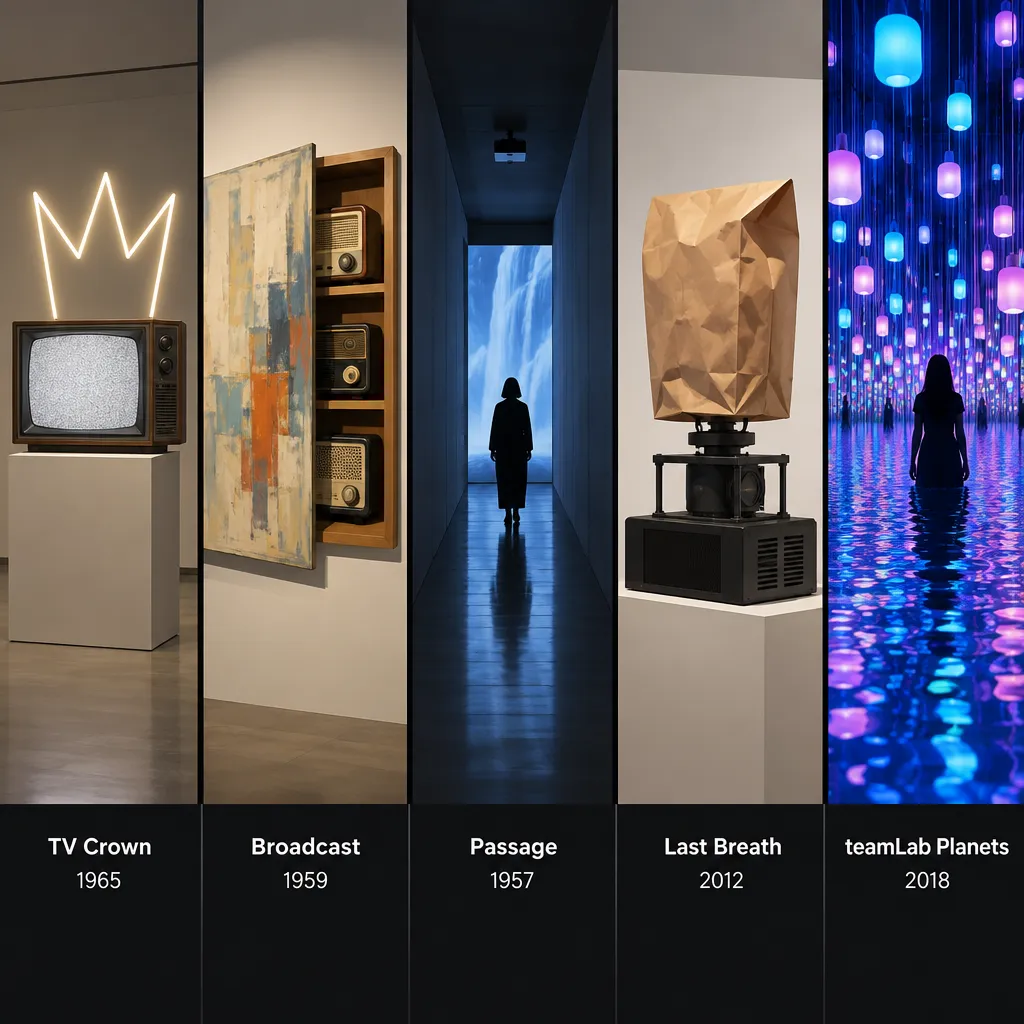
Many people search “What are 5 examples of artwork?” when what they want is a short list of famous technology-based works. Start with these five:
- Nam June Paik, TV Crown (1965). A television whose circuitry was altered so that audio signals bent the picture into looping, crown-like line patterns.
- Robert Rauschenberg, Broadcast (1959). A painting with three hidden radios that viewers could re-tune.
- Bill Viola, Passage (1987). A slowed-down video of a child’s birthday party, projected at the end of a narrow corridor.
- Rafael Lozano-Hemmer, Last Breath (2012). A machine that stores one person’s breath and keeps it moving in and out of a paper bag.
- teamLab Planets (2018). A walk-through Tokyo museum of projected, sensor-driven rooms, some of them flooded with water.
Media art vs mixed media vs multi-media vs new media
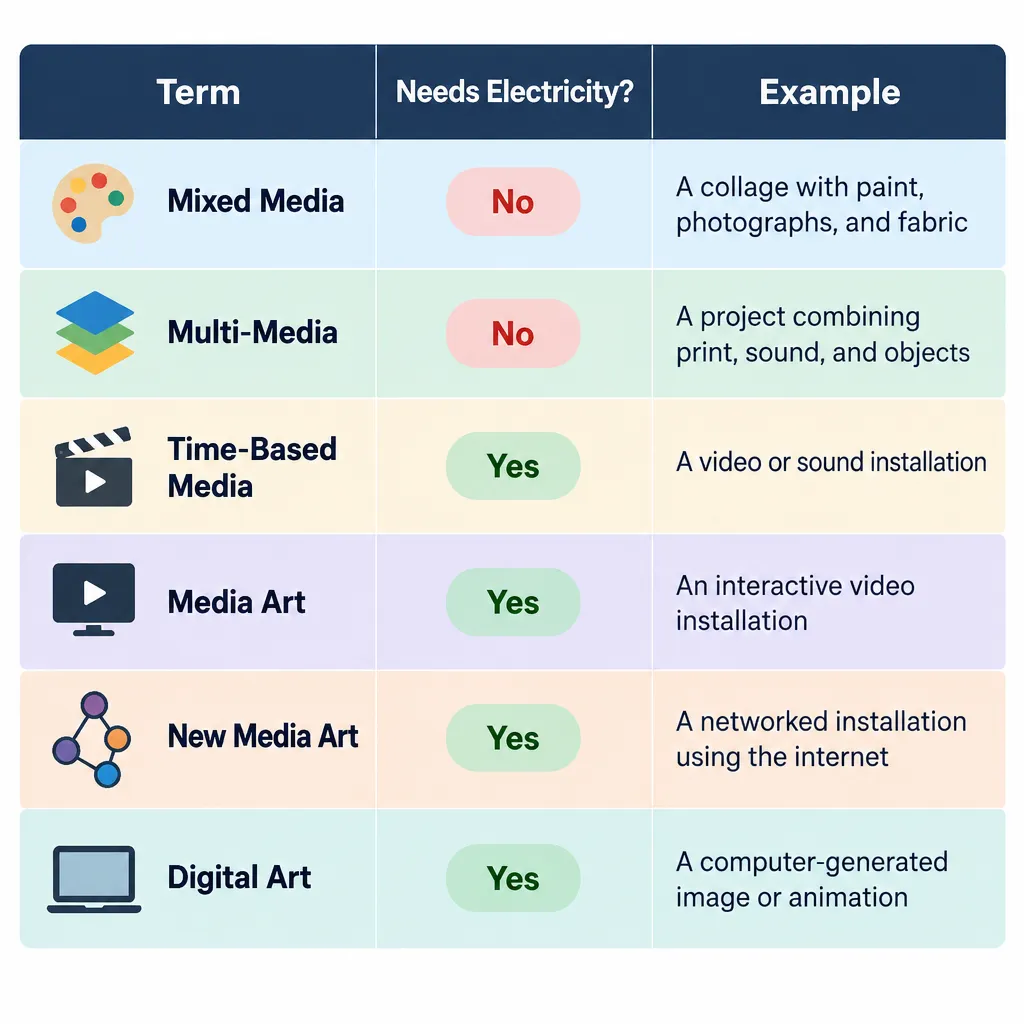
These terms overlap, and that is why searches for “examples of media in art” bring up such mixed results. Media art and multi-media use electronic technology. Mixed media combines physical materials. New media is a historical label for work made with digital and networked technologies.
| Term | Definition | Needs electricity or tech? | Example work | Source of definition |
|---|---|---|---|---|
| Medium / art media | The material an artwork is made from: oil paint, bronze, video, code | Only if the medium is electronic | Any work, by material | General art usage |
| Mixed media | Artwork made from more than one material, dated by Tate to around 1912 | No | Picasso and Braque’s cubist collages | Tate glossary |
| Multi-media | Works that include electronic media such as video, film, audio and computers | Yes | Christian Marclay, The Clock (2010) | Tate glossary |
| Time-based media | Works with duration that unfold over time: video, film, slide, sound, performance | Usually | Bill Viola, Passage (1987) | Museum conservation usage (SFMOMA, Tate) |
| Media art | Art that depends on a technological component to function | Yes | Nam June Paik, TV Buddha (1974) | SFMOMA Media Arts |
| New media art | Art made with digital, networked or interactive technologies, mostly from the 1990s on | Yes | JODI, wwwwwwwww.jodi.org (1995) | Common usage, Wikipedia |
| Digital art | Any art made or shown with digital technology, including static prints | Only to make it, sometimes | Vera Molnár’s plotter drawings | Common usage |
Mixed media (Picasso, Braque, around 1912)
According to Tate, mixed media began with the cubist collages Pablo Picasso and Georges Braque made around 1912. Those works added newspaper, wallpaper and rope to paint. Tate’s mixed-media page lists artists such as Kurt Schwitters, Eileen Agar, Peter Blake, Chris Ofili, Tracey Emin and Phyllida Barlow. All of them combine physical materials. None of their best-known works need power.
If you searched “mixed media” and want collage or assemblage, this page covers a different subject. The two do meet in mixed media digital art, where a scanned collage is animated or projected. Once the projector matters to the work, it counts as media art.
Multi-media and time-based media
Tate defines multi-media as work that includes electronic media such as video, film, audio and computers. Museums often use “time-based media” for the same group, because what these works share is duration. You watch them over time rather than all at once. Our guide to multimedia artworks covers how each element (sound, image, interaction) does its job inside a piece.
New media and digital art
On forums, people often ask what counts as new media art and what is “just” digital art. The clearest line is behavior. A digital print is digital art made with a computer, and it hangs on a wall. A piece that responds, generates, connects to a network or runs live is new media art. “New” has also aged: net art from 1995 is now 31 years old, so many curators simply say media art.
The types of media art, with examples
Media art splits into roughly nine types, sorted by the technology each depends on. Each type below gives a definition, a few dated works and a line on how the technology works.
| Type | Core technology | Typical input | Typical output | Key example | Beginner tool to try (free) |
|---|---|---|---|---|---|
| Video art | Camera, monitor, projector | Recorded or live footage | Screen image | Paik, TV Buddha (1974) | Shotcut, phone camera |
| Film and expanded cinema | Film projector, light, haze | Film strip | Light in space | McCall, Line Describing a Cone (1973) | p5.js with a projector |
| Sound art | Speakers, microphones, synths | Recorded or live sound | Spatial audio | Cardiff, The Forty Part Motet (2001) | Pure Data, Audacity |
| Interactive art | Sensors, cameras, code | Visitor’s body, pulse, touch | Light, image, sound | Lozano-Hemmer, Pulse Room (2006) | p5.js, Arduino IDE |
| Internet and net art | Browser, server, HTML | Clicks, URLs | Web pages | JODI, wwwwwwwww.jodi.org (1995) | Any text editor |
| Generative art | Algorithms, randomness | Rules and seeds | Images, motion | Harold Cohen, AARON (from 1973) | p5.js, Processing |
| Immersive installation | Projection mapping, sensors | Visitor movement | Room-scale image | teamLab Planets (2018) | TouchDesigner non-commercial |
| AI and data art | Machine learning models | Datasets | Generated image and sound | Anadol, Unsupervised (2022) | ml5.js |
| Kinetic, robotic, bio art | Motors, robots, living systems | Programs, sensors | Physical motion, organisms | Sun Yuan and Peng Yu, Can’t Help Myself (2016) | Arduino IDE |
Video art and video installation
Video art uses moving images from a camera or a signal, shown on monitors or as projections. It grew up in the 1960s, once portable video and broadcast TV were within artists’ reach.
- Wolf Vostell, TV De-collages (from 1958): televisions used as raw material and deliberately disrupted.
- Nam June Paik, TV Buddha (1974): a Buddha statue watches itself on a monitor through a closed-circuit camera.
- Bill Viola, Passage (1987): SFMOMA lists it as a single-channel video installation with color and stereo sound, 144 × 720 × 192 inches. The museum acquired it in 1990.
- Ragnar Kjartansson, The Visitors (2012): nine screens, each showing a musician in a different room of one house, all playing the same song together.
How it works: a camera or tape (now a media player) sends a signal to a display. The installation design controls where you stand and how long you watch.
Film, slide and expanded cinema
Expanded cinema takes film out of the movie theater. The projector, the beam and the room become part of the work.
- Anthony McCall, Line Describing a Cone (1973): a 16mm projector draws a circle over about 30 minutes. In a hazy room, the beam becomes a solid-looking cone of light you can walk through.
- Christian Marclay, The Clock (2010): a 24-hour montage of film clips showing clocks, synced to local time, so the film always tells you the real time.
- John Akomfrah, Vertigo Sea (2015): a three-screen film about the ocean, migration and whaling, first shown at the 2015 Venice Biennale.
- Arthur Jafa, Love Is the Message, The Message Is Death (2016): about seven minutes of found footage of Black life in America, edited to Kanye West’s “Ultralight Beam”.
How it works: projection plus editing. The Clock runs on a computer synced to the local clock. McCall’s cone needs a film projector and a haze machine.
Sound art
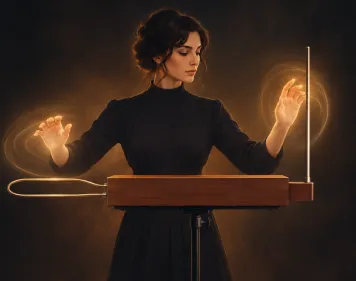
Sound art uses sound as the main material, usually placed in space rather than performed as a concert. The theremin, played without touch since the 1920s, is an early ancestor. Today the form runs from speaker arrays to field recordings.
- Janet Cardiff, The Forty Part Motet (2001): 40 speakers, each playing one voice from a choir singing Thomas Tallis’s Spem in alium. You walk among the voices.
- Ryoji Ikeda, test pattern (from 2008): sound and data turned into pulsing black-and-white barcodes on screen.
How it works: multichannel playback. Every speaker carries its own recorded track, so where you stand changes what you hear.
Interactive art
Interactive art changes in response to what you do. Your body, voice or pulse becomes the input.
- Robert Rauschenberg, Broadcast (1959): viewers turned knobs to re-tune three radios hidden behind the painting.
- Myron Krueger, Videoplace (mid-1970s): a camera captured visitors’ silhouettes, and a computer let them interact with graphic creatures on a screen.
- Jeffrey Shaw, The Legible City (1989): you pedal a fixed bicycle through a city whose buildings are made of 3D letters.
- Rafael Lozano-Hemmer, Pulse Room (2006): a sensor reads your heartbeat, and a bulb flashes in time with it. The Musée d’art contemporain de Montréal describes the installation keeping the previous 300 pulses moving across a grid of incandescent bulbs.
How it works: sensor, then software, then output. Pulse Room reads a heart rate, maps it to a dimmer channel and shifts older readings down the grid.
Internet and net art
Net art is made for the browser. The work is the website, the code and sometimes the network itself.
- JODI, wwwwwwwww.jodi.org (1995): Joan Heemskerk and Dirk Paesmans founded JODI in 1995. The page looks like broken green code. View its source and you find hidden drawings.
- Lynn Hershman Leeson, Agent Ruby (1998–2002): an online chatbot commissioned by SFMOMA. The museum calls it a pioneering project about AI and one of the first online works in its collection.
How it works: HTML, scripts and a server. The fragile parts are the browser and the plugins, which keep changing underneath the work.
Generative and computer-based art
Generative art comes from rules the artist writes. The computer runs those rules and produces outcomes the artist did not draw by hand.
- Harold Cohen, AARON (from 1973): a drawing program Cohen developed for decades. The Whitney Museum showed it in 2024.
- Vera Molnár, (Des)Ordres (1974): plotter drawings of nested squares that break their own grid.
- Cory Arcangel, Super Mario Clouds (2002): a hacked Nintendo cartridge with everything erased except the scrolling clouds.
How it works: an algorithm plus a seed. Change one number and the whole image changes, which is why generative artists save their seeds.
Immersive installation
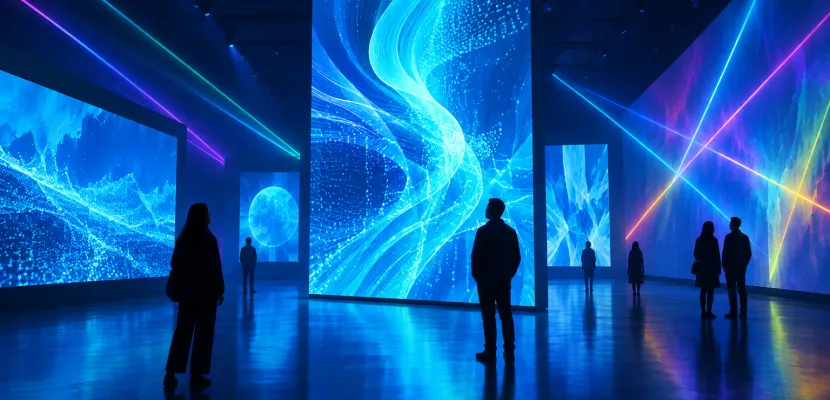
Immersive installations surround you with image and sound, usually through projection mapping and motion sensors.
- Char Davies, Osmose (1995): a virtual-reality piece you steer by breathing, through a vest that tracks your chest.
- teamLab Borderless (2018): projected works that move between rooms. It reopened at Azabudai Hills, Tokyo, in 2024.
- teamLab Planets (2018): in some rooms at the Toyosu site you walk barefoot through water.
How it works: dozens of projectors, depth cameras and a real-time engine. The software tracks where you are and redraws the image around you. Our guides to post processing in games and to depth testing cover the same real-time graphics ideas.
AI and data art
AI art uses machine-learning models trained on datasets. The data becomes the material.
- Refik Anadol, Unsupervised (2022): a model trained on MoMA’s collection, shown on a large screen in the museum’s lobby.
- Refik Anadol Studio, Machine Dreams: Rainforest (2026): DATALAND’s opening show, built on the studio’s Large Nature Model, which is trained on nature data.
- Forensic Architecture, A Cartography of Genocide (2026 Golden Nica): spatial and data analysis presented as an interactive cartography.
How it works: a model generates or sorts images and sound from training data in real time. Large screens or LED walls show the result.
Kinetic, robotic and bio art
This type moves or lives. Motors, robots or organisms do the work.
- Tatsuo Miyajima, Counter Void (2003): giant LED counting digits on a wall at Roppongi Hills, Tokyo.
- Eduardo Kac, GFP Bunny (2000): a rabbit, Alba, bred to glow green under blue light.
- Sun Yuan and Peng Yu, Can’t Help Myself (2016): an industrial robot arm in a glass enclosure, endlessly sweeping a red liquid back toward itself. It is in the Guggenheim’s collection.
- Jim Campbell, Day for Night (2018): an LED display in the crown of San Francisco’s Salesforce Tower showing low-resolution videos of city life.
How it works: microcontrollers and motors driven by code. Campbell’s work relies on low resolution: from a distance, your brain fills in the missing detail.
30 landmark media artworks, 1959–2026
This table covers the works that come up again and again in museum collections, histories of the field and prize lists. Works were picked for three reasons: historical firsts, the range of technologies, and whether you can still see the work or its documentation. The list stays mostly sorted by year so you can follow how the tools changed.
| Year | Artist | Work | Type | Made with | Where to see it |
|---|---|---|---|---|---|
| 1959 | Robert Rauschenberg | Broadcast | Interactive | Painting, three radios | Rauschenberg retrospectives |
| 1965 | Nam June Paik | TV Crown | Video | Modified TV, audio signals | Paik retrospectives |
| 1973 | Anthony McCall | Line Describing a Cone | Expanded cinema | 16mm film, projector, haze | Museum screenings |
| 1973 on | Harold Cohen | AARON | Generative / AI | Custom software, plotters | Whitney Museum (2024 show) |
| 1974 | Nam June Paik | TV Buddha | Video sculpture | Statue, camera, monitor | SFMOMA |
| 1974 | Vera Molnár | (Des)Ordres | Generative | Computer, plotter | Museum print collections |
| Mid-1970s | Myron Krueger | Videoplace | Interactive | Camera, computer, projection | Documentation |
| 1987 | Bill Viola | Passage | Video installation | Single-channel video, corridor | SFMOMA collection |
| 1989 | Jeffrey Shaw | The Legible City | Interactive | Bicycle, computer graphics | ZKM Karlsruhe |
| 1995 | JODI | wwwwwwwww.jodi.org | Net art | HTML, browser | Online |
| 1995 | Nam June Paik | Electronic Superhighway | Video installation | Hundreds of monitors, neon | Smithsonian American Art Museum |
| 1995 | Char Davies | Osmose | VR / immersive | Headset, breath-tracking vest | Documentation |
| 1996 | Bill Viola | The Crossing | Video installation | Two-sided projection, sound | Guggenheim collection |
| 1998–2002 | Lynn Hershman Leeson | Agent Ruby | Net / AI | Chatbot, web | SFMOMA online |
| 2000 | Eduardo Kac | GFP Bunny | Bio art | Transgenic rabbit | Documentation |
| 2001 | Janet Cardiff | The Forty Part Motet | Sound | 40 speakers | Touring; National Gallery of Canada |
| 2002 | Cory Arcangel | Super Mario Clouds | Generative / game | Hacked NES cartridge | Gallery editions |
| 2003 | Tatsuo Miyajima | Counter Void | Kinetic / light | LED digits | Roppongi Hills, Tokyo |
| 2006 | Rafael Lozano-Hemmer | Pulse Room | Interactive | Heart-rate sensor, bulbs | MAC Montréal collection |
| 2008 on | Ryoji Ikeda | test pattern | Sound / data | Projection, speakers | Touring |
| 2010 | Christian Marclay | The Clock | Film / video | 24-hour montage, sync software | Tate, MoMA and others |
| 2012 | Ragnar Kjartansson | The Visitors | Video installation | Nine-channel video | SFMOMA (shown 2025) |
| 2012 | Rafael Lozano-Hemmer | Last Breath | Kinetic / interactive | Bellows, paper bag, electronics | Lozano-Hemmer surveys |
| 2015 | John Akomfrah | Vertigo Sea | Film | Three-channel video | Museum collections |
| 2016 | Arthur Jafa | Love Is the Message, The Message Is Death | Video | Found footage | Museum collections |
| 2016 | Sun Yuan and Peng Yu | Can’t Help Myself | Robotic | Industrial robot, sensors | Guggenheim collection |
| 2018 | teamLab | teamLab Planets | Immersive | Projectors, sensors, water | Toyosu, Tokyo |
| 2018 | Jim Campbell | Day for Night | Light / video | LED crown display | Salesforce Tower, San Francisco |
| 2022 | Refik Anadol | Unsupervised | AI / data | Machine-learning model, LED screen | MoMA collection |
| 2026 | Refik Anadol Studio | Machine Dreams: Rainforest | AI / immersive | Large Nature Model, five galleries | DATALAND, Los Angeles |
Did you know?
Wikipedia’s history of new media art calls Robert Rauschenberg’s Broadcast (1959) one of the first interactive artworks. Viewers re-tuned three hidden radios, decades before the personal computer.
A short timeline of media art
Media art is older than electricity in galleries. It starts with 19th-century optical toys. It then moves through light, television and the web, and reaches AI.
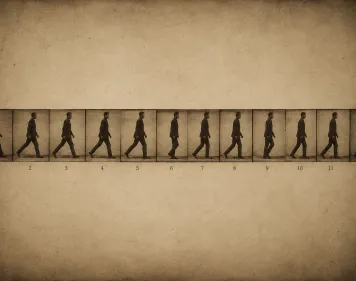
- 1833: Joseph Plateau’s phenakistiscope makes drawings appear to move. Eadweard Muybridge’s sequential photography follows in 1878.
- 1919: Thomas Wilfred builds his first Clavilux and calls his light art “Lumia”.
- 1958: Wolf Vostell begins his TV De-collages.
- 1959: Rauschenberg’s Broadcast puts working radios inside a painting.
- 1963: Nam June Paik’s Exposition of Music, Electronic Television, at Galerie Parnass in Wuppertal, uses altered TVs.
- 1960s–70s: portable video arrives. Paik, Viola and others develop video art as its own field.
- 1987: SFMOMA establishes its Department of Media Arts, one of the first in a US museum.
- 1992: the CAVE virtual-reality room, from the University of Illinois Chicago’s Electronic Visualization Laboratory, debuts at SIGGRAPH.
- 1995: SFMOMA launches its website and soon begins commissioning web projects. JODI forms the same year.
- 2019: teamLab Borderless sets a Guinness World Record for attendance.
- 2022: MoMA shows Refik Anadol’s Unsupervised.
- 2026: DATALAND opens in Los Angeles on June 20.
Media art in 2026: what’s new
In 2026 the field is pulling in two directions. Prize juries reward work about war and politics, while AI and immersive venues pull in mass audiences. Both directions show up in this year’s biggest events.
Prix Ars Electronica 2026 winners
The Prix Ars Electronica, based in Linz, Austria, is the field’s longest-running major prize. Its top award is the Golden Nica. The organisers announced the 2026 winners on June 22, 2026. There were 4,329 submissions from 106 countries. The jury noted that every winning work deals with the major conflicts and upheavals of our time.
| Category | Artist | Work | Country |
|---|---|---|---|
| New Animation Art | Andrew Herzog | Deer Hunter | US |
| Interactive Art+ | Forensic Architecture | A Cartography of Genocide: Israel’s Conduct in Gaza Since October 2023 | GB |
| Digital Humanity | SummitShare with the Shared Histories Team | Open digital infrastructure for shared cultural heritage | Zambia / Sweden |
| u19–create your world | Jannis Berner | Reverse Rendering | AT |
Each Golden Nica carries €10,000. The New Animation Art category alone drew 1,144 submissions. 2026 was also Digital Humanity’s first year as a full Golden Nica category. The jury praised SummitShare for centering Indigenous women custodians from Zambia. The awards ceremony took place on September 10, during the Ars Electronica Festival (September 9–13, 2026).
Did you know?
The 2026 Golden Nica for Interactive Art+ went to Forensic Architecture, a research agency, for its cartography of the Gaza war, according to Prix Ars Electronica. The prize went to investigators, not a gallery artist.
DATALAND and the AI art museum
DATALAND bills itself as the world’s first Museum of AI Arts. Refik Anadol and Efsun Erkılıç co-founded it. It opened on June 20, 2026 inside Frank Gehry’s The Grand LA in downtown Los Angeles. It has five galleries across 25,000 square feet of public space. Another 10,000 square feet hold the technology systems that run them.
That ratio says a lot. The machines need almost half as much floor space as the visitors do. The opening show, Machine Dreams: Rainforest, runs through January 31, 2027. Not every critic is convinced. Coverage has asked openly whether a data-driven spectacle counts as a museum. That debate is worth following if you work with AI yourself.
Plan your visit
If you are going to DATALAND, check that Machine Dreams: Rainforest is still on before you book. It is scheduled to run only through January 31, 2027.
Immersive art at mass scale
Immersive media art now draws crowds the size of a major museum’s. teamLab says teamLab Planets in Tokyo welcomed 2,504,264 visitors between April 1, 2023 and March 31, 2024. Guinness recorded that as the most-visited museum dedicated to a single art group. It was teamLab’s second such record. In 2019, teamLab Borderless drew 2,198,284 visitors by teamLab’s own count, more than the Van Gogh Museum’s 2,134,778 that year.
The honest counter-argument is that big attendance rewards spectacle over slow looking. A work like Viola’s Passage needs you to stand still. A packed immersive room pushes you on. Both kinds are media art, and they make different demands on you.
Where to see media artworks in person and online
You can see major media art in the US, in Tokyo and in Linz. Plenty of it is also free in your browser.
In the US
- SFMOMA, San Francisco: the Department of Media Arts covers video, film, slide, sound, computer-based and online work, and performance. Check the galleries for what is on view. Passage, for example, is in storage at the moment.
- DATALAND, Los Angeles: AI art in five galleries at The Grand LA.
- Smithsonian American Art Museum, Washington, D.C.: home of Paik’s Electronic Superhighway.
- MoMA, New York: holds Anadol’s Unsupervised and a large video collection.
- Day for Night, San Francisco: visible at night from much of the city, on top of Salesforce Tower.
Worldwide
- teamLab Planets (Toyosu) and teamLab Borderless (Azabudai Hills), Tokyo.
- Ars Electronica Center, Linz: open all year, with the festival each September.
- ZKM Center for Art and Media, Karlsruhe: a major collection of interactive and computer art.
- Tate Modern, London: film and video in its collection displays.
Online works you can open right now
You can open SFMOMA’s online artworks for free, including Hershman Leeson’s Agent Ruby, and JODI’s site is still live. Net art is the one type you can usually see in its original medium on your own screen.
Studio tip
Before you plan a trip, open a museum’s online artworks first. SFMOMA’s online works show you net art the way it was meant to be seen, in a browser.
Why media artworks break, and how museums keep them alive
Media artworks disappear because their technology does. Screens, players, file formats and browsers go obsolete faster than paint or bronze. Conservators then have to choose between migrating a work to new hardware and maintaining the original equipment.
Migration vs maintenance
Migration means moving the work to new equipment, such as a tape copied to a digital file or a CRT image moved to a flatscreen. Maintenance means keeping the original equipment alive. Conservators at the Art Institute of Chicago note that CRT-based works cannot move to flatscreens without undermining the artist’s intent. A CRT’s curved glass, glow and scan lines are part of the work. So the museum repairs CRTs and even builds its own repair tools.
The need is growing worldwide. Singapore’s Heritage Conservation Centre opened its first Media Conservation Lab in 2024.
Heads up
CRT monitors are getting scarce and contain high voltages even when unplugged. Leave repairs to trained technicians.
Lessons for artists making work today
Your work will outlive your laptop. Do these things while you still remember how the piece works:
- Record versions. Note the software, library and operating system versions (for example, p5.js 2.2.2 and Chrome on macOS).
- List the hardware. Write down monitor models, projector lumens, sensor part numbers and cable types.
- Archive the source. Save the code, the media files and any random seeds together, in open formats.
- Write install specs. Draw the room layout, screen heights, light levels and sound volume.
- Say what can change. Tell future conservators whether a flatscreen is acceptable or whether the CRT is essential.
Make your own: one mini project per type
Rebuilding a small version of a landmark work is the fastest way to understand it. Each project below uses free tools and fits into one session.
| Project | Inspired by | Time | Tools (all free) |
|---|---|---|---|
| Generative sketch | Molnár, AARON | 30 minutes | p5.js Editor |
| Webcam mirror | Krueger, Lozano-Hemmer | 45 minutes | p5.js, webcam |
| Sound-reactive visual | Ikeda, Cardiff | 30 minutes | p5.js with p5.sound, microphone |
| One-page net artwork | JODI | 20 minutes | Text editor, browser |
| TV Crown tribute | Paik | 20 minutes | p5.js (see Try it live) |
Generative sketch in p5.js
The idea: thousands of tiny walkers follow a noise field, so the rules draw the image. p5.js 2.0 launched in April 2025. The p5.js Editor switched its default for new sketches to 2.x in August 2026, and v2.2.2 is dated February 22, 2026. This sketch runs on 1.x and 2.x alike.
// Generative flow field: walkers follow Perlin noise
let walkers = [];

function setup() {
  createCanvas(600, 600);
  background(245);
  stroke(20, 30);
  for (let i = 0; i < 800; i++) {
    walkers.push(createVector(random(width), random(height)));
  }
}

function draw() {
  for (let w of walkers) {
    // noise picks a direction for each spot on the canvas
    let angle = noise(w.x * 0.004, w.y * 0.004) * TWO_PI * 2;
    let nx = w.x + cos(angle);
    let ny = w.y + sin(angle);
    line(w.x, w.y, nx, ny);
    w.set(nx, ny);
    // send walkers back if they leave the canvas
    if (w.x < 0 || w.x > width || w.y < 0 || w.y > height) {
      w.set(random(width), random(height));
    }
  }
}
Variations: add noiseSeed(42) in setup() to make one exact image you can repeat. Change 0.004 to 0.02 for tighter swirls.
Studio tip
If old tutorial code breaks in the Editor, check the version picker. p5.js 2.x dropped preload() in favour of an async setup(), so tutorials written for 1.x may need a small rewrite or an older version selected.
Interactive webcam piece
The idea: in the spirit of Videoplace and Lozano-Hemmer, your body becomes the input. The camera image turns into a grid of dots that grow where the picture is bright.
// Webcam mirror made of dots
let cam;

function setup() {
  createCanvas(640, 480);
  cam = createCapture(VIDEO);
  cam.size(64, 48); // small size keeps it fast
  cam.hide();
  noStroke();
}

function draw() {
  background(0);
  cam.loadPixels();
  for (let y = 0; y < 48; y++) {
    for (let x = 0; x < 64; x++) {
      let i = (x + y * 64) * 4;
      let b = (cam.pixels[i] + cam.pixels[i + 1] + cam.pixels[i + 2]) / 3;
      fill(255, 120, 60);
      // flip x so it behaves like a mirror
      circle(width - x * 10, y * 10, map(b, 0, 255, 1, 11));
    }
  }
}
Your browser will ask for camera permission. The p5.js Editor runs over HTTPS, which the camera requires.
Sound-reactive visuals
The idea: loudness controls the size of a shape, the core of most audio-reactive work. This snippet uses the p5.sound 1.x API, so pick a 1.x version in the Editor, where p5.sound is included.
// Microphone level drives a pulsing circle
let mic;

function setup() {
  createCanvas(600, 400);
  mic = new p5.AudioIn();
}

function mousePressed() {
  userStartAudio(); // browsers need a click before audio starts
  mic.start();
}

function draw() {
  background(10, 30);
  let level = mic.getLevel();
  let d = map(level, 0, 0.3, 10, 380, true);
  fill(80, 200, 255);
  noStroke();
  circle(width / 2, height / 2, d);
}
A one-page net artwork
The idea: like JODI’s work, the browser itself is the material. Save this as index.html and open it in any browser.
<!doctype html>
<html>
<head>
  <title>loading...</title>
  <style>
    body { background:#000; color:#0f0; font:14px monospace; }
  </style>
</head>
<body>
  <!-- view the source: the real artwork hides here -->
  <pre id="out"></pre>
  <script>
    const chars = "01/\\|_-#";
    setInterval(() => {
      let s = "";
      for (let i = 0; i < 2000; i++) {
        s += chars[Math.floor(Math.random() * chars.length)];
      }
      document.getElementById("out").textContent = s;
      document.title = s.slice(0, 12); // the tab title glitches too
    }, 120);
  </script>
</body>
</html>
Variation: put an ASCII drawing in an HTML comment, as JODI did. People who open the page source will find it.
FAQ
What are examples of media arts?
Examples include Nam June Paik’s TV Buddha (1974), Bill Viola’s Passage (1987), JODI’s wwwwwwwww.jodi.org (1995), Christian Marclay’s The Clock (2010) and teamLab Planets (2018). Each one needs a screen, a projector, a network or sensors to exist.
What are the types of media art?
The main types are video art, film and expanded cinema, sound art, interactive art, net art, generative and computer art, immersive installation, AI and data art, and kinetic, robotic and bio art. VR and AR works usually sit under immersive.
What are 5 examples of artwork?
For technology-based art, start with Paik’s TV Crown, Rauschenberg’s Broadcast, Viola’s Passage, Lozano-Hemmer’s Last Breath and teamLab Planets. For traditional examples, a painting, sculpture, collage, print and photograph each count.
What are some examples of art media?
Art media are the materials of a work: oil paint, watercolor, charcoal, clay, bronze, photography, video, sound, light and code. Media art uses the electronic ones.
What is the difference between media art and mixed media?
Mixed media combines physical materials, such as paint, paper and found objects, and needs no power. Media art depends on technology to function. Tate dates mixed media to Picasso and Braque’s collages around 1912.
What is the difference between new media art and digital art?
Digital art covers anything made with digital tools, including static prints. New media art usually behaves: it responds, generates, runs live or lives on a network.
Is AI art considered media art?
Yes. AI art depends on software and models to function, so it passes the unplug test. DATALAND and the Prix Ars Electronica both treat it as part of the field. Artists who are new to it often begin with vibe coding, prompting an AI assistant to write the code. That is a fast way to start, but you still have to read and own the code.
Are video games media art?
Some are, and the art world agrees. MoMA added video games to its collection in 2012. Artists such as Cory Arcangel also use games as material, as in Super Mario Clouds (2002). A commercial game can be art without being made as a gallery work.
Who is the father of video art?
Nam June Paik is widely called the father of video art. His 1963 Wuppertal show used altered televisions, and from the mid-1960s he worked with portable video. Wolf Vostell worked with TV sets in the same years.
Where can I see media art in the US?
SFMOMA in San Francisco, DATALAND in Los Angeles, MoMA in New York and the Smithsonian American Art Museum in Washington, D.C. are the strongest bets. SFMOMA’s online artworks are free in any browser.
Is a new media or media art degree worth it?
It depends on whether the program teaches you to build things. Graduates who can code, wire sensors and run installations have more options. Those who only study theory have fewer. Look at what recent graduates actually built and where they work before you enroll.
What jobs do new media graduates actually get, art or computer science?
Usually a mix of both. Common paths include creative technologist, interactive designer, installation technician, motion designer, front-end developer, museum AV or media conservator, and studio assistant at firms such as teamLab or Refik Anadol Studio. Technical skill gets you most of these jobs.
Should I keep a paying job and do media art on the side?
For most people, yes, at least at first. Many media artists support their practice with technical work, and grants and prize money are irregular. A steady job pays for hardware and gives you time to build a portfolio.
Which p5.js version should I use, since my old tutorial code broke?
For new projects, use p5.js 2.x, which the Editor now uses by default. To follow an older tutorial, switch the sketch to a 1.x version in the Editor settings. The most common break is preload(), which 2.x replaced with async loading in setup().
Try it live
This TV Crown tribute imitates what Paik did with a rewired television. Two oscillators bend loops of light. Move your mouse to change the two frequencies, as if you were turning a signal knob. Click to clear the screen. Once it runs, try saving your favourite mouse positions as numbers. That is how you begin documenting a media artwork, and how this one could survive its own technology.
// TV Crown tribute: oscillators bend loops of light like a rewired TV
let t = 0;

function setup() {
  createCanvas(800, 600);
  colorMode(HSB, 360, 100, 100, 100);
  background(0);
  strokeWeight(1.5);
  noFill();
}

function draw() {
  // a see-through black layer leaves glowing trails, like old phosphor
  background(0, 0, 0, 12);

  push();
  translate(width / 2, height / 2);

  // mouse position sets the two oscillator frequencies
  let fx = map(mouseX, 0, width, 1, 7);
  let fy = map(mouseY, 0, height, 1, 7);
  let wobble = 20 * sin(t * 0.7);

  // draw six nested loops, each a little bigger and shifted in color
  for (let ring = 0; ring < 6; ring++) {
    let r = 120 + ring * 25;
    stroke((t * 20 + ring * 40) % 360, 80, 100, 70);
    beginShape();
    for (let a = 0; a <= TWO_PI + 0.01; a += 0.02) {
      let x = r * sin(fx * a + t + ring * 0.3);
      let y = r * 0.75 * sin(fy * a + ring * 0.5);
      // fake signal interference
      x += wobble * sin(a * 13 + t * 3);
      y += random(-1.5, 1.5);
      vertex(x, y);
    }
    endShape();
  }
  pop();

  // dark horizontal scan lines for a CRT look
  stroke(0, 0, 0, 30);
  strokeWeight(1);
  for (let y = 0; y < height; y += 4) {
    line(0, y, width, y);
  }
  strokeWeight(1.5);

  t += 0.01;
}

// click to wipe the screen clean
function mousePressed() {
  background(0);
}
On this article
- Facts were checked against the sources below before publication.
- Published
Sources (8)
- Media Arts | SFMOMA (sfmoma.org)
- Bill Viola, Passage | SFMOMA (sfmoma.org)
- Discussion Questions: Nam June Paik's TV Buddha | SFMOMA (sfmoma.org)
- SFMOMA Announces Acquisition of 63 Works Across Media (sfmoma.org)
- JODI | SFMOMA (sfmoma.org)
- Past Exhibitions | SFMOMA (sfmoma.org)
- TV Buddha - Wikipedia (en.wikipedia.org)
- Prix Ars Electronica Winners (ars.electronica.art)